Vacuuming water after a leak or a flood
A leaking washing machine, a burst hot water cylinder, a cellar flooded after a storm: a wet and dry vacuum is the tool for the first few minutes. Here is the method, from safety to drying, with the limits to know.
Contents
In brief: turn off the water and, if needed, the electricity to the area. Remove the filter bag, fit the floor nozzle, set the vacuum down somewhere dry and work slowly. When the float shuts off suction, the motor runs faster: switch off and empty. Beyond a hundred litres or so, a submersible pump is better suited.
Safety first
Water and electricity are a dangerous mix. Before getting the vacuum out, take a few seconds to make the area safe.
- Turn off the water supply: the appliance’s valve, the stopcock for the property or at the meter.
- Turn off the electricity to the area at the consumer unit if the water may have reached sockets, extension leads, an electrical appliance or the consumer unit itself. If in doubt about your installation, call an electrician.
- Do not walk in water near an appliance that is plugged in.
- Plug the vacuum in at a dry socket, outside the flooded area, earthed and ideally protected by an RCD.
- Identify the water: clean water from a pipe does not carry the same risks as sewage. For sewage or floodwater, wear gloves and boots, and disinfect everything afterwards.
Never vacuum water mixed with petrol, heating oil or solvents: these are flammable liquids.
Preparing the vacuum
- Remove the filter bag: Kärcher recommends vacuuming liquids without a bag. A bag soaked with water can tear and block the suction.
- Keep the cartridge filter in place on a model such as the Kärcher WD 3: it protects the motor and does not need changing.
- Empty the tank if it contains dust, so you do not make mud.
- Fit the floor nozzle with its rubber strips, which squeegee the water, or keep the tube alone for deep water.
- Unwind the cable fully and place the appliance somewhere dry.
The method step by step
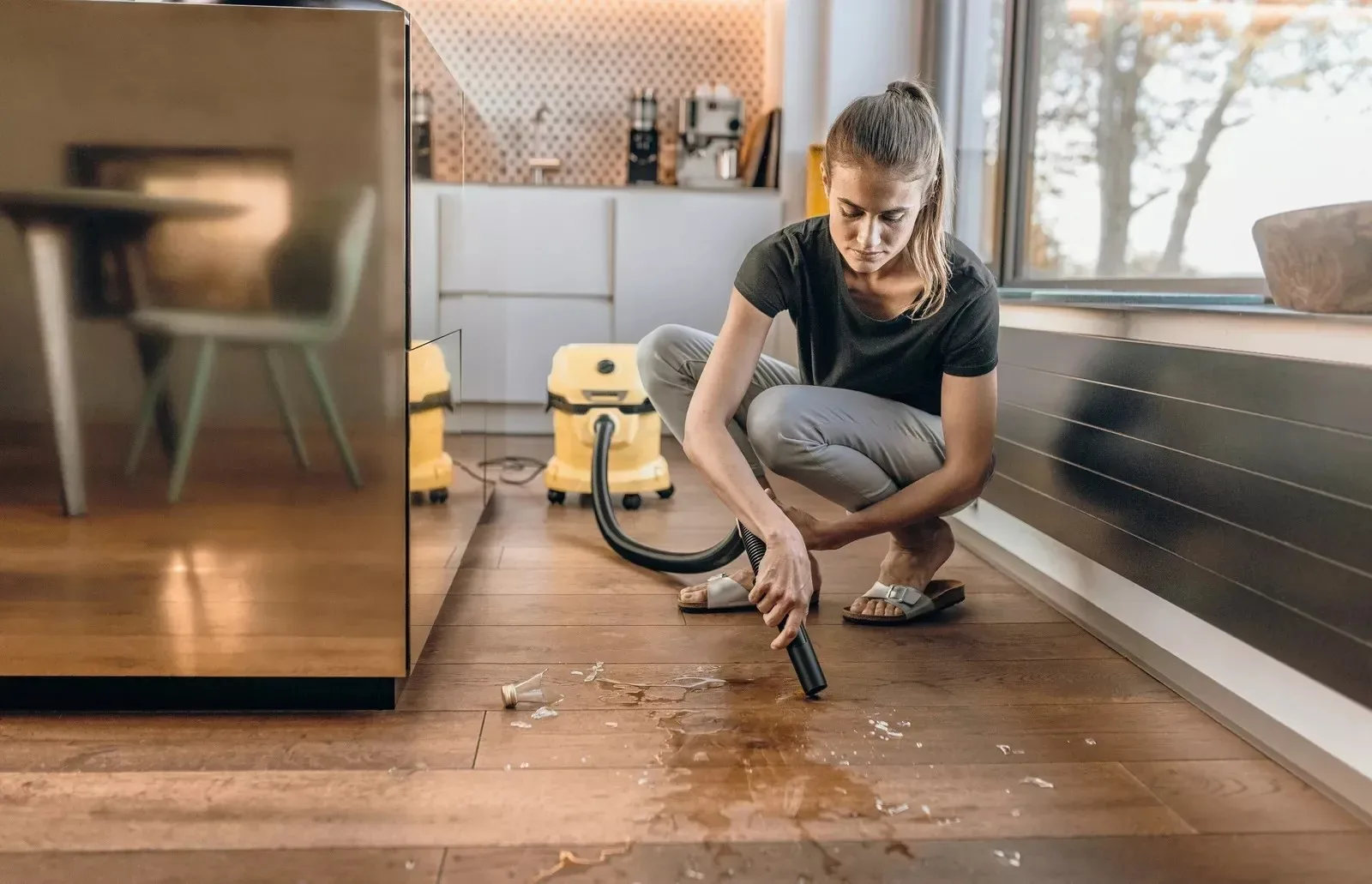
- Start at the lowest point, where water collects, or at the deepest area.
- For several centimetres of water, dip the end of the tube in the water, without a nozzle: suction is faster.
- When only a film of water remains, switch to the floor nozzle, held flat, and draw it slowly towards you.
- Listen to the motor constantly: a change in pitch signals a full tank.
- Empty as soon as the float cuts out, then carry on.
- Finish along the edges, the skirting boards and under the furniture, with the crevice nozzle.
- Make a last pass crosswise with the floor nozzle to collect the final traces.
The float: how it works
A wet and dry vacuum has a float, a small part that rises with the water level in the tank. When the water reaches the maximum level, the float blocks the suction opening on the motor side, to stop water reaching the filter and the motor.
Kärcher makes a point that is often misunderstood: the appliance does not stop. The motor keeps running, but faster, since it is no longer drawing air. This change of sound is what signals a full tank. You must then switch off the appliance and empty the tank.
If the appliance tilts or is shaken, the float may close before the tank is full. Set it down flat and let it settle.
How many emptyings to expect
The number of emptyings depends on the volume of water and the tank. With a 17 L tank like the WD 3 V’s, allow at least:
| Situation | Indicative volume | Minimum emptyings (17 L tank) |
|---|---|---|
| Overflowing sink or dishwasher | 2 to 10 L | 1 |
| Washing machine leak | 10 to 30 L | 1 to 2 |
| Burst 150 L hot water cylinder | Up to 150 L | Up to 9 |
| Cellar with 1 cm of water over 10 m² | 100 L | 6 |
These volumes are orders of magnitude. The cellar calculation is simple: 10 m² × 1 cm gives 0.1 m³, or 100 litres. A tank’s usable volume is a little below its nominal capacity, because the float closes before the maximum level. Our calculator does the sum for you.
A 17 L tank full of water weighs about 17 kg, plus the weight of the tank. To empty it into a sink, lift it by the tank, not by the head, and get help if needed.
Situation by situation
The leaking washing machine or dishwasher
Switch off the appliance and its supply valve, unplug it, then pick up the water on the floor. Tilt the appliance slightly to reach the water that has crept underneath. Then check the inlet hose, the drain hose and the machine’s drain filter.
The hot water cylinder
Turn off the cylinder’s electricity supply and the cold water feed. Let the water cool before vacuuming it: very hot water can damage plastics. A 150 to 200 L cylinder means many emptyings: a pump is often more practical.
The flooded cellar
If the cellar holds more than a few centimetres of water, a submersible pump is the right first step. The vacuum takes over for the last few centimetres, the corners and the film of water the pump cannot reach.
The garage or the patio
Rainwater, melted snow, water from a burst hose: the vacuum quickly does the job with the floor nozzle. Empty clean water onto the garden or into a drain.
The bathroom
Overflowing bath, blocked shower: you pick up the water on the floor, then you can try to suck out the blockage in the trap with the hose, making a seal with a cloth.
Wet rugs, carpets and fabrics
A rug or carpet soaked with water holds a lot of liquid. A wet and dry vacuum helps extract some of it:
- pass the floor nozzle slowly, pressing lightly, in several directions;
- for a rug, take it out if possible and vacuum it flat on a hard surface;
- then dry it in the open air, with good ventilation or a dehumidifier.
A carpet left wet for more than a few days risks developing mould. For a large area, a professional drying company may be needed. A wet and dry vacuum is not a carpet cleaner: it picks up water, it does not deep-clean the carpet.
When the vacuum is no longer enough
- Beyond a hundred litres or so or several centimetres over a large area: a submersible pump is faster.
- When water keeps coming in: rising groundwater, flooding, continuous seepage. The source must be dealt with.
- When the water is contaminated: sewage, floodwater. Health precautions are essential, and a professional may be needed.
- When the electrical installation is affected: call an electrician.
After vacuuming: drying and cleaning
The room
- Ventilate thoroughly, and heat gently if possible.
- Use a dehumidifier or fans.
- Raise the furniture and remove the skirting boards if water has got behind them.
- Watch for mould in the days that follow.
The vacuum
- Empty the tank and rinse it with clean water.
- Rinse the cartridge filter under running water, without rubbing or brushing.
- Rinse the nozzles and the hose by vacuuming a little clean water.
- Leave everything to dry in the open air, with the tank open.
- After dirty water, disinfect the tank.
Do not use the appliance for dust again until the filter is completely dry. Our maintenance guide gives the full routine.
Water damage: what to do next
Water damage should be reported to your home insurer as soon as possible, within the time limit set by your policy. Before cleaning up, take photos of the water, the damage and the source of the leak. Keep damaged items and receipts. If the leak comes from or affects a neighbour, or the building’s landlord or managing agent, let them know straight away. The exact conditions depend on your policy: check them with your insurer.
Mistakes to avoid
- Keeping the bag in: it soaks up water, tears and blocks the suction.
- Letting it run after the float cuts in: the motor races for nothing. Switch off and empty.
- Standing the appliance in water or leaving the plug and extension lead in a wet area.
- Vacuuming with a filter already clogged with dust: it turns into a compact mud. Clean it first, or accept you will have to rinse it afterwards.
- Lifting the full tank by the head: the lock is not designed to carry 17 kg of water.
- Putting the appliance away wet: smells and deposits guaranteed within a few days.
- Vacuuming water mixed with hydrocarbons: heating oil, petrol or solvents are flammable.
Where to empty the water
Where to empty it depends on what kind of water it is:
- Clean water (drinking water pipe, rain, untreated pool water): onto the garden, into a gutter or a drain.
- Soapy or washing water (washing machine, dishwasher): into a sink, a toilet or a drain connected to the foul sewer.
- Dirty or contaminated water (sewage, floodwater): into a toilet or a foul drain, never onto the garden or into a surface water drain.
- Treated pool water: depending on local rules, often to the foul sewer rather than the garden.
Drainage rules vary from one area to another: if in doubt, check with your local council or water company.
Vacuum or submersible pump
| Criterion | Wet and dry vacuum | Submersible pump |
|---|---|---|
| Large volumes | Many emptyings | Continuous discharge through a hose |
| Film of water, last few millimetres | Very effective with the floor nozzle | Leaves a residual depth of water |
| Corners, under furniture | Yes, with the crevice nozzle | No |
| Versatility | Also handles dust and debris | Water only |
The two tools complement each other: the pump to remove the bulk, the vacuum to finish off and dry the surfaces. For a house without a flood-prone cellar, the vacuum is enough in the vast majority of cases.
Preventing the next leak
- Turn off the washing machine’s supply valve when you are away for a long time.
- Check the water inlet hoses regularly, as they age.
- Have an old hot water cylinder checked.
- Fit a leak detector near high-risk appliances.
- In a flood-prone cellar, raise sensitive items and keep the vacuum above floor level.
- Keep the vacuum ready: tank empty, filter dry, bag removed if its main use is water.
The summary at a glance
| Step | Action | Why |
|---|---|---|
| Make safe | Turn off the water, and the electricity to the area if needed | Avoid electrocution and limit the volume |
| Prepare | Remove the bag, keep the filter, fit the floor nozzle | The bag tears in water |
| Position | Appliance and plug somewhere dry | Electrical safety |
| Vacuum | Tube in deep water, floor nozzle for the film of water | Speed, then finishing |
| Listen | Motor revving up | The float has closed: tank full |
| Empty | Switch off, lift by the tank, empty in the right place | Carry on with an empty tank |
| Finish | Corners with the crevice nozzle, crosswise pass | Collect the last traces |
| Dry | Ventilate the room, rinse and dry the vacuum | Avoid mould and smells |
| Report | Photos, insurer within the time limit | Protect your claim |
Keep this table in mind: in the rush of a leak, the safety steps and the no-bag set-up are the ones most often forgotten.
Being ready before the next leak
In a leak, every minute counts: water seeps under furniture, into skirting boards and through floors. A vacuum stored at the back of a cupboard, with a clogged filter and no extension lead, wastes precious time. A few simple precautions change everything:
- store the vacuum somewhere accessible, near a socket, and above floor level if it is in a cellar;
- keep the tank empty and the filter dry;
- find out in advance where the stopcock and the consumer unit are;
- keep an extension lead in good condition next to the appliance;
- note your insurer’s phone number and policy number.
Prepared like this, you limit the damage in the first few minutes, when the vacuum is most useful.
After major water damage
After major flooding, a wet and dry vacuum remains useful long after the first few hours: it picks up water seeping back out of floors, collects dried mud and debris during the clean-up, and helps during repair work. Empty and rinse it after each session so that the mud does not dry in the tank and the hose.
Keep in mind that drying a building properly takes time. Floors, plaster and insulation can hold moisture for weeks after the surface looks dry. The vacuum deals with standing water and surface moisture; for deep drying, dehumidifiers and, for serious damage, professional drying equipment are the right tools. Your insurer can usually advise you on approved specialists.
Frequently asked questions
Do you need to remove the filter to vacuum water?
Not the cartridge filter of a Kärcher WD 3, which stays in place. Just remove the bag.
Does the vacuum stop when the tank is full?
No. The float closes off suction and the motor runs faster. You have to switch it off and empty the tank.
Can you vacuum hot water?
Let it cool: very hot water can damage the plastics and poses a risk of scalding.
Can you vacuum seawater or pool water?
Yes, then rinse the tank, the filter and the accessories carefully with fresh water.
How long does the filter take to dry?
Several hours in the open air, often overnight.
Cleaning without limits.
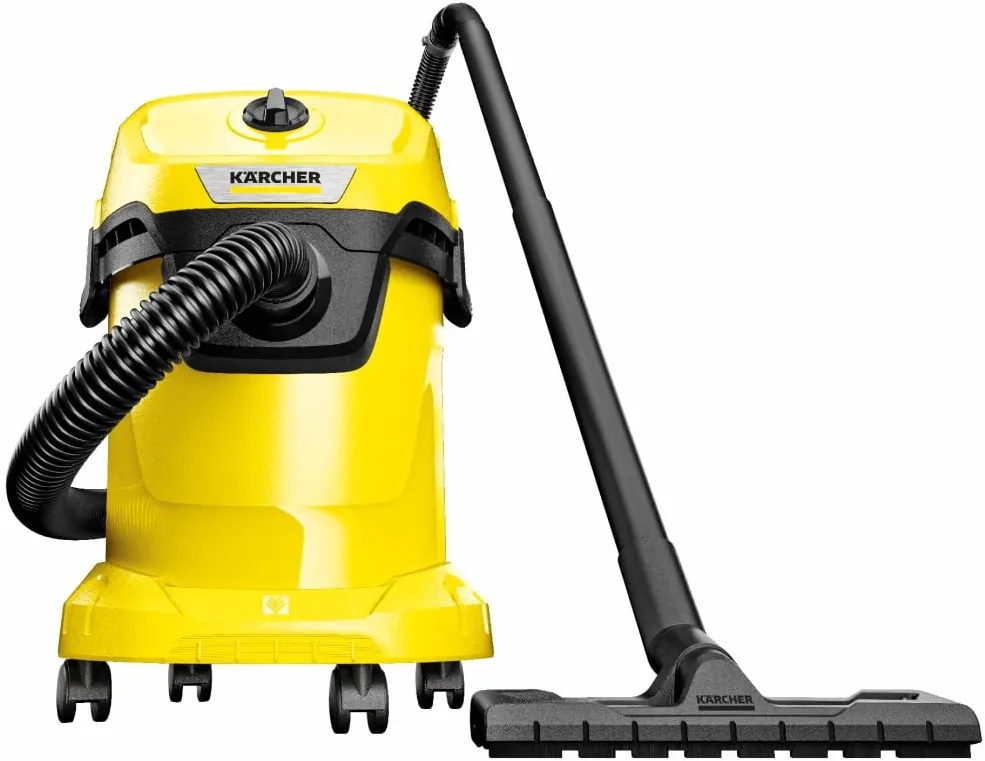
1000 W · 17 L tank · 2 m hose · 4 m cable · blower · cartridge filter. Prices change often on Amazon: check the price, the seller and the exact version (WD 3 V, WD 3 S, WD 3 P) before you order.
Check the price on AmazonAffiliate link · new tab