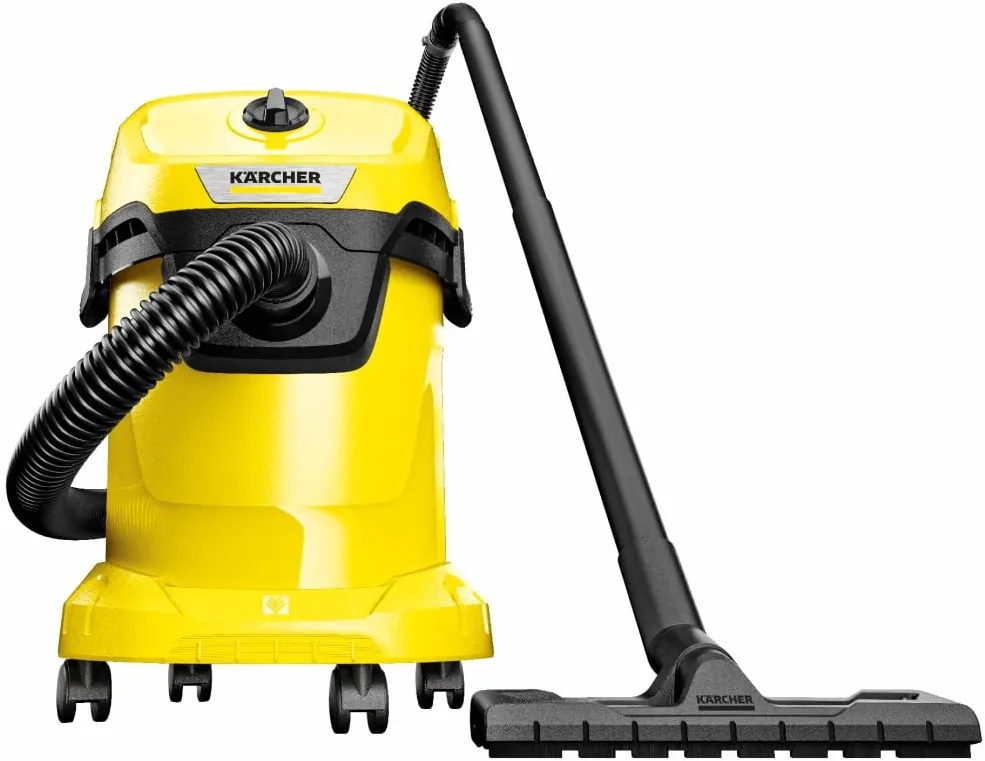
Every use of a wet and dry vacuum, from the garage to the garden
A water leak, sawdust, leaves, crumbs in the car, plaster dust: a wet and dry vacuum is good for far more than you might think. Here is each use, with the set-up that works and the limits to know.
Contents
In brief: a wet and dry vacuum covers water, debris, sawdust, soil, leaves and dust from building work, as long as you adapt the filter (bag for fine dust, no bag for water) and the nozzle. It does not replace a household vacuum for everyday floor cleaning, and it must never pick up ash, flammable liquids or hazardous dust.
One tool, one set-up per use
The versatility of a wet and dry vacuum rests on two simple settings: the filter set-up and the choice of nozzle. Chosen well, they let you switch from a water leak to a drilling job in seconds. Chosen badly, they give the impression of an appliance that does not suck.
- The filter: with a cartridge filter like the Kärcher WD 3’s, it stays in place. You add a bag for fine dust and remove it for water.
- The floor nozzle: for flat surfaces, dry or wet.
- The crevice nozzle: for corners, grooves, car seats, radiators.
- The tube alone: for coarse debris that would struggle to pass under a nozzle.
- The hose alone: with the handle, for tight spaces.
Bear one rule of order in mind: do the dry tasks before the wet ones, because a wet filter makes dust stick. Our how-to guide details each step. The sections that follow go through each room of the house and each situation, from the most common to the most unexpected.
Household vacuum or wet and dry vacuum?
The two appliances complement each other. A household vacuum is made for regular cleaning of the floors and rugs at home: it is quiet, manoeuvrable and fitted with brushes suited to rugs and wooden floors. A wet and dry vacuum takes over for everything that would damage it.
| Task | Household vacuum | Wet and dry vacuum |
|---|---|---|
| Everyday floors and rugs | Yes | In an emergency |
| Water, liquids | Never | Yes |
| Light rubble, soil, gravel | No | Yes |
| Sawdust, shavings | Not recommended | Yes |
| Plaster, sanding dust | No: bag and motor overloaded | Yes, with a bag |
| Car | Possible | Yes, sturdier |
| Leaves, patio | No | Yes |
Using a household vacuum for plaster dust is a common mistake: the very fine dust passes through or saturates the bag, clogs the motor and can destroy it. This is precisely the case where a wet and dry vacuum with a bag makes sense.
Water: leaks, floods, overflows
This is the use behind many wet and dry vacuum purchases: a leaking washing machine, a burst hot water cylinder, a failed pipe, a cellar that takes on water after a storm.
- Make it safe: turn off the water supply, and the power to the area if the water may have reached an electrical installation.
- Remove the bag: Kärcher recommends vacuuming liquids without a bag.
- Fit the floor nozzle with its rubber strips to squeegee the water, or vacuum with the tube if there are several centimetres of water.
- Place the appliance somewhere dry, plug and cable out of the water.
- Empty as soon as the float cuts out: the motor revs up, switch off and empty.
- Finish with the corners and under the furniture, then ventilate to dry.
With a 17 L tank, a 50 L flood needs at least three emptyings. Beyond a hundred litres or so, a submersible pump is more effective. Our guide vacuuming water after a leak or flood covers each situation, including wet rugs and carpets.
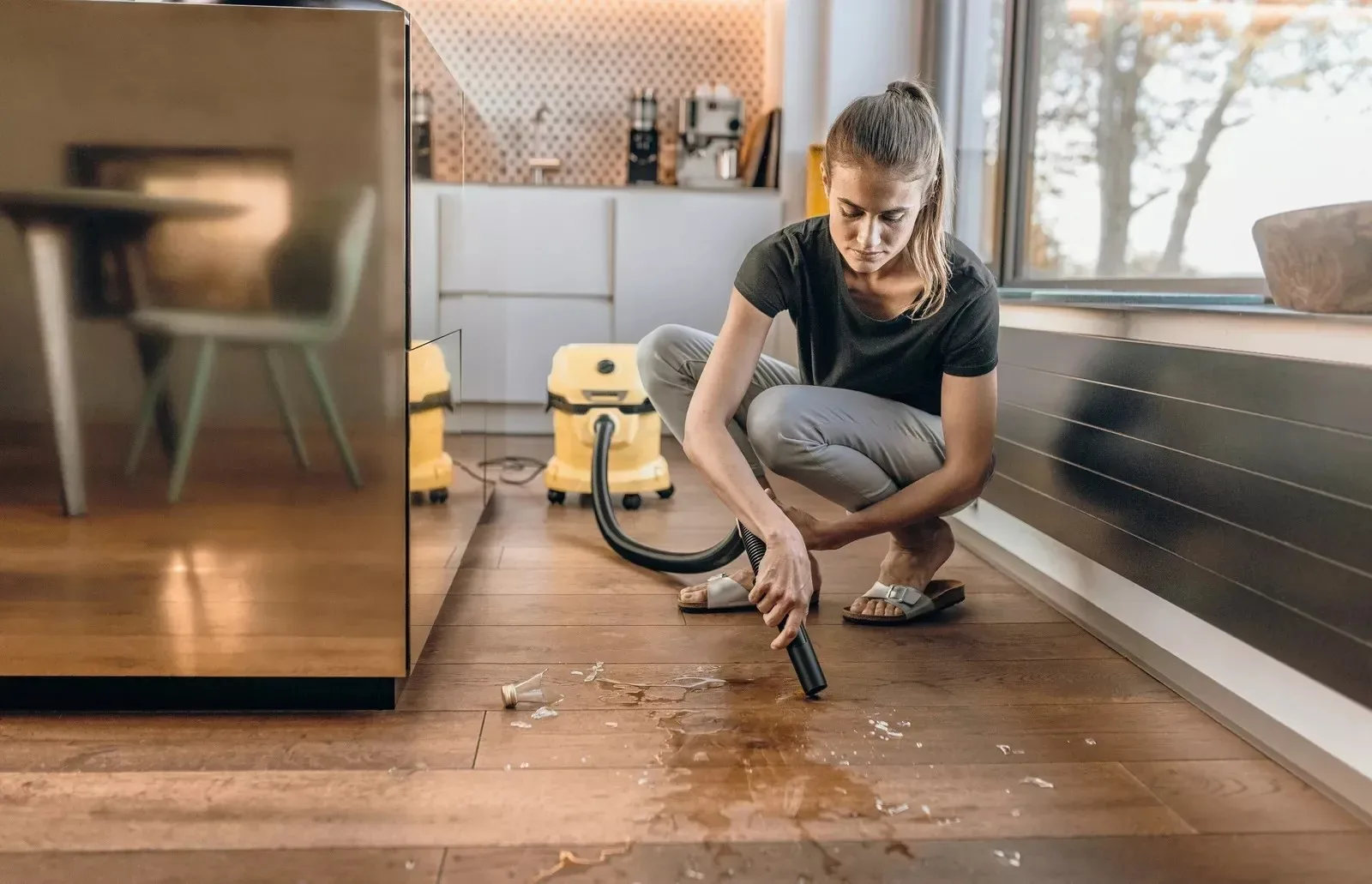
Kitchen and bathroom
In wet rooms, a wet and dry vacuum does occasional but valuable jobs:
- an overflowing sink or dishwasher: you pick up the water before it seeps under the units;
- a broken glass or jar: shards and liquid go together, without cutting yourself;
- a blocked trap: by sucking directly with the hose, you can sometimes clear a basin or shower trap, wrapping a cloth around the end to make a seal;
- skirting boards and under the units during a big clean, with the crevice nozzle.
After wet use, rinse the tank and the filter and leave them to dry: food scraps or soapy water soon start to smell.
Cellar, utility room, boiler room
Cellars and utility rooms combine dust, cobwebs, debris and the risk of water. A wet and dry vacuum naturally belongs there:
- dusting shelves and corners with the crevice nozzle;
- picking up water from seepage or an overflowing sump;
- cleaning around a boiler, switched off and cold, without picking up soot or ash;
- collecting debris after a clear-out: cardboard, soil, gravel.
Kärcher lists the cellar among the WD 3 V’s areas of use. For a flood-prone cellar, keep the appliance nearby, above floor level.
Garage
The garage is the wet and dry vacuum’s natural territory. Leaves, soil brought in by the wheels, gravel, cobwebs and dust all accumulate there.
- The floor: floor nozzle and tubes, moving slowly.
- Corners and the base of the walls: crevice nozzle.
- Shelves: crevice or brush nozzle, or the blower to chase the dust away.
- Puddles: rainwater or melted snow brought in by the car, without a bag.
Stored in the garage, the appliance is always ready for the car, the patio and the unexpected. The WD 3 V’s built-in storage (hose, cable, accessories) really comes into its own here.
Workshop and DIY
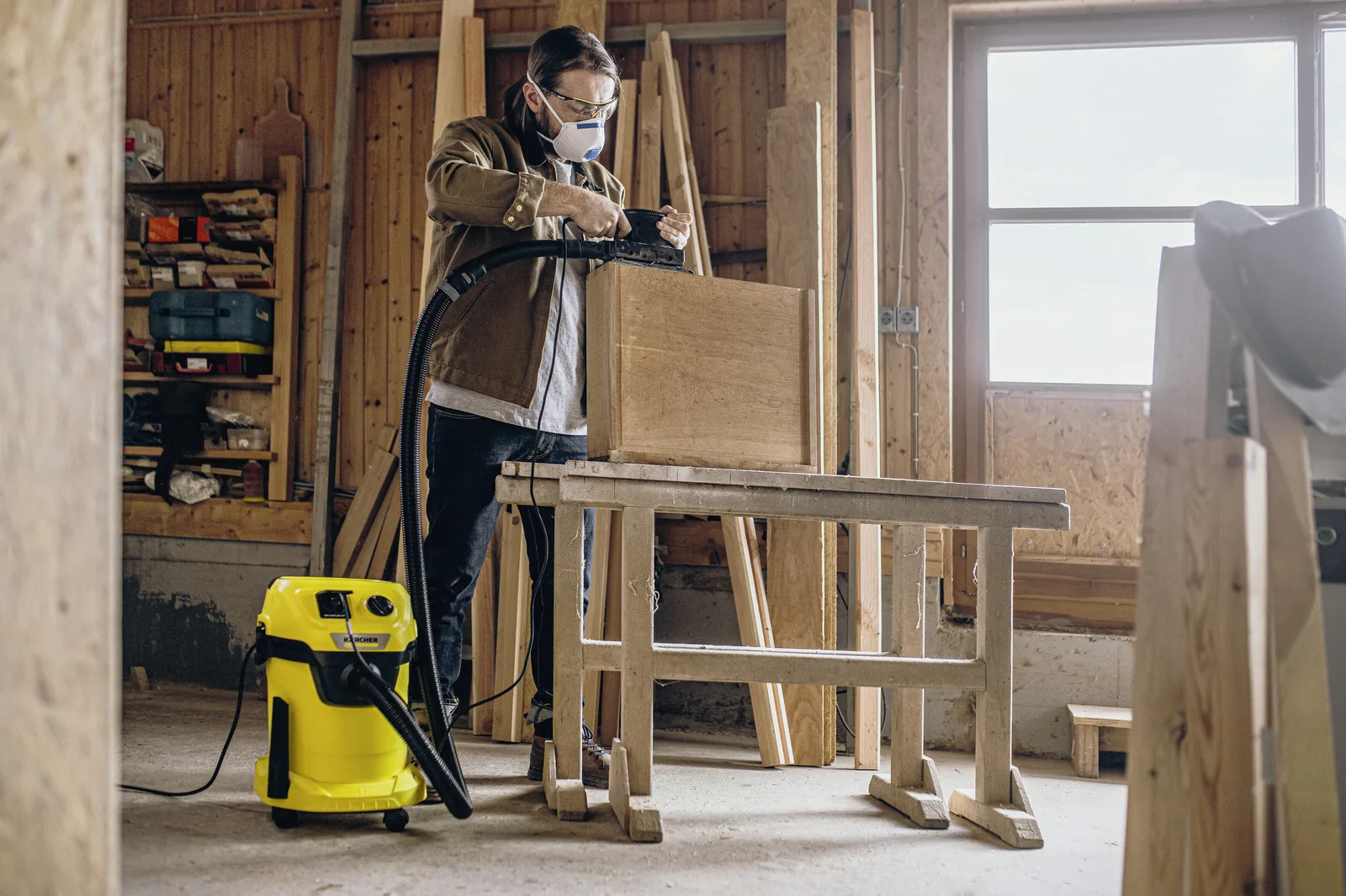
In the workshop, a wet and dry vacuum picks up sawdust, shavings, drilling dust, offcuts and screws. Kärcher lists the workshop among its areas of use.
| Task | Set-up | Tip |
|---|---|---|
| Planer shavings, offcuts | Filter alone, tube without nozzle | Empty before the tank is full |
| Saw dust | Filter and bag recommended | Vacuum as you go |
| Sanding dust | Filter and bag necessary | Change the bag before it is saturated |
| Drilling into a wall | Filter and bag, drilling dust collector | Extract at source |
| Workbench, machines | Crevice nozzle or blower | Goggles for the blower |
To extract directly behind a sander or a saw, you need a tool socket that starts the vacuum with the tool. The WD 3 V does not have one: the WD 3 P version does. A tool extraction kit and a drilling dust collector are available among Kärcher’s accessories.
Renovation and building work
The WD 3 V’s Amazon listing mentions renovation work among its uses. That is true for occasional jobs: stripping wallpaper, knocking down a light partition, drilling, light sanding. For heavy renovation, a few precautions are essential.
- Bag mandatory for plaster, filler and cement, and plan for several bags.
- Vacuum often rather than all at once, to avoid saturating the filter.
- Empty heavy rubble regularly: a tank full of plaster is heavy.
- Clean the filter as soon as suction drops.
- Protect your lungs with a suitable mask.
On a job lasting several weeks with a lot of sanding, a model with filter cleaning (WD 5 or WD 6 at Kärcher) will be more comfortable. And if you suspect asbestos, do not touch anything: asbestos is a matter for certified professionals.
Car, campervan, boat
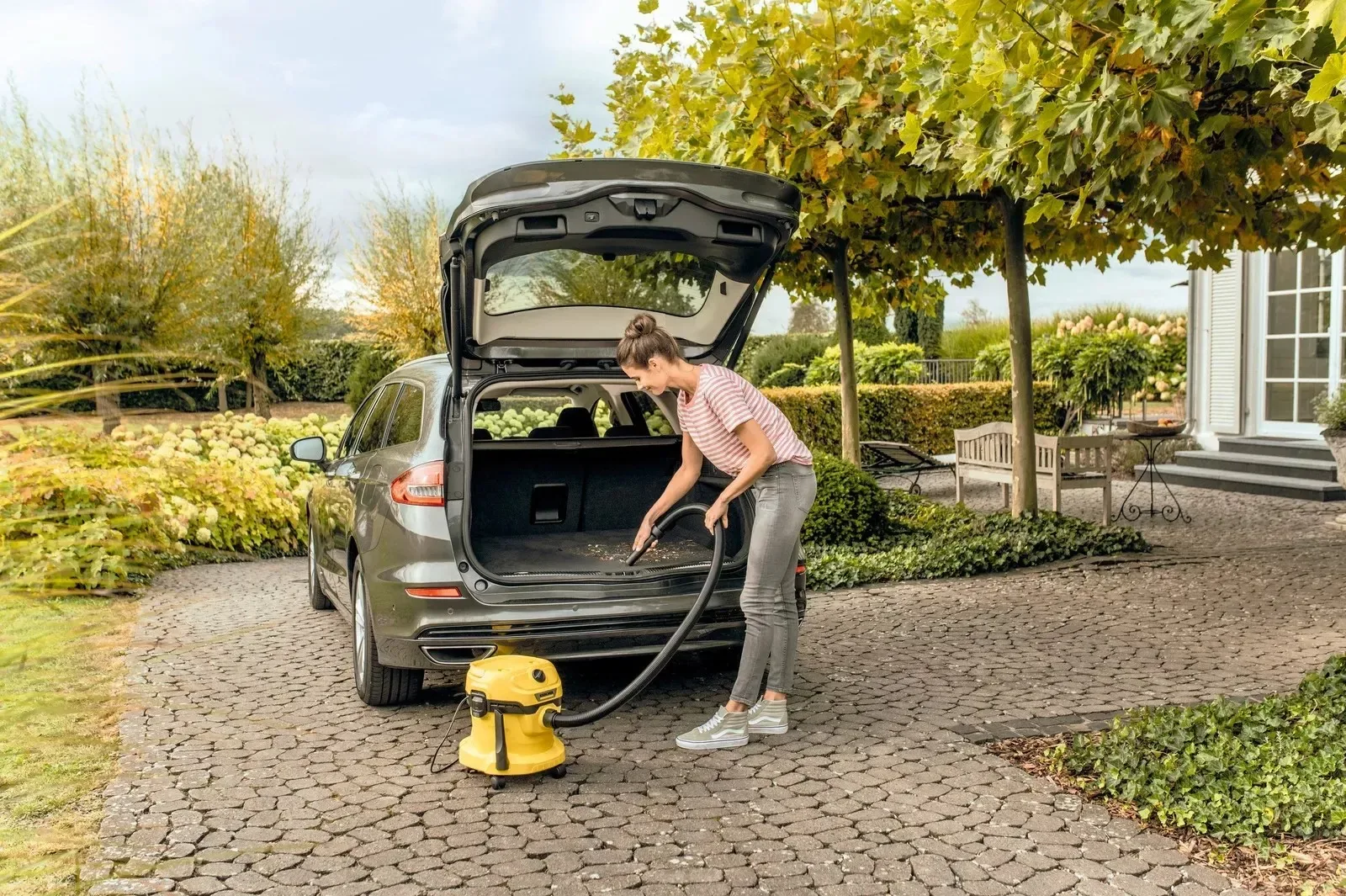
A car’s interior collects crumbs, sand, pet hair, gravel and soil. A wet and dry vacuum picks them up faster than a handheld vacuum, and also deals with a liquid spilled on a seat.
- Take out the mats and empty the door pockets.
- Fit the crevice nozzle directly onto the hose handle, without a tube.
- Vacuum from top to bottom: seats, then door sills, then the floor.
- Go between and under the seats with the crevice nozzle.
- Vacuum the mats separately, on the ground.
- Finish with the boot.
With a 4 m cable and a 2 m hose, plan an extension lead if the car is parked far from a socket. A car kit and an interior cleaning kit are available from Kärcher. Our guide vacuuming your car details the complete method, right up to the campervan.
Patio, balcony, paths
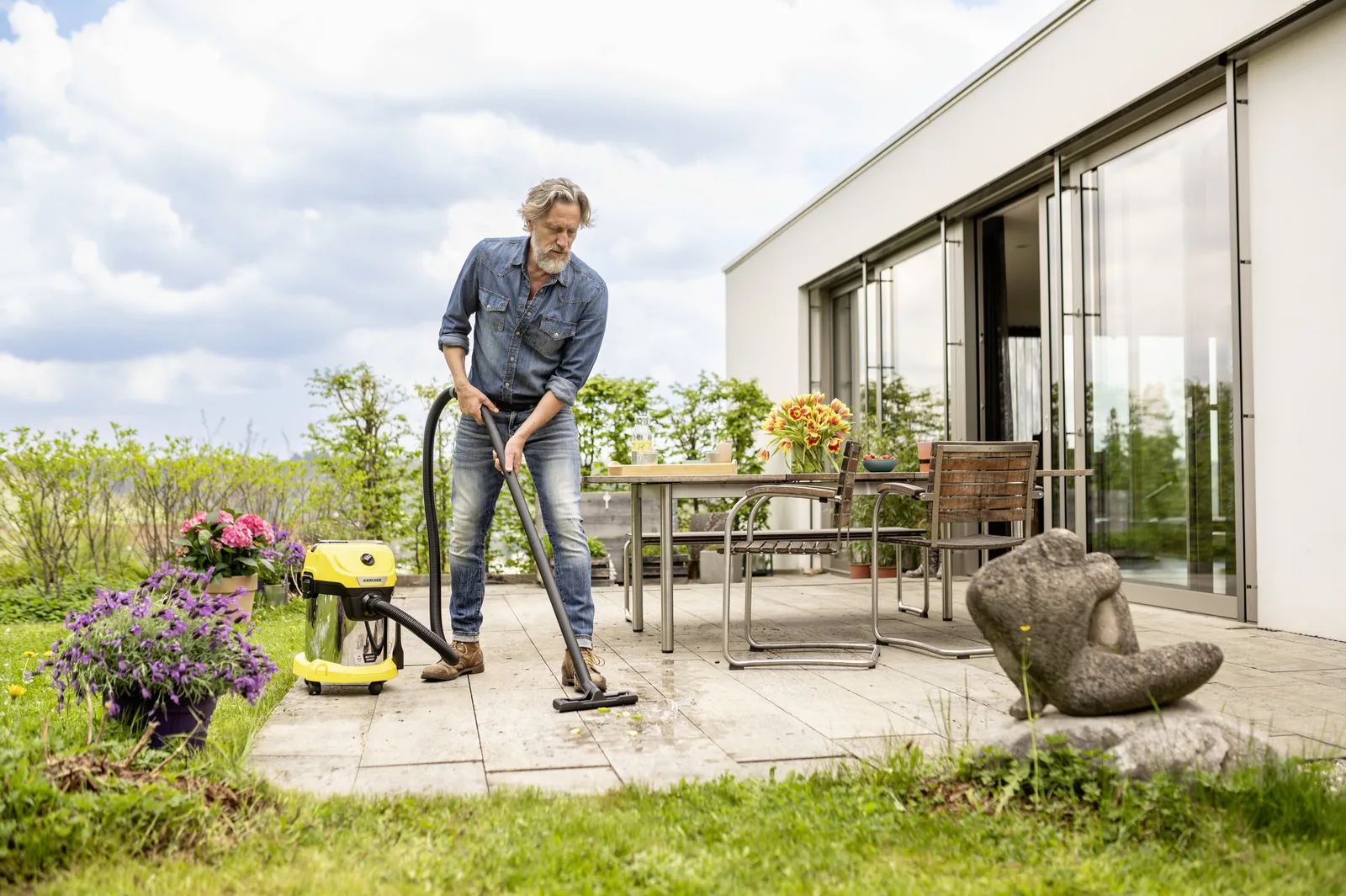
On a patio, a wet and dry vacuum picks up leaves, pine needles, soil, gravel and standing water after rain. Kärcher lists patios among its areas of use.
- Dry leaves: floor nozzle and tubes, or the blower to gather them.
- Wet leaves: without a bag, emptying often.
- Joints between slabs: crevice nozzle for soil and debris.
- Standing water: floor nozzle with rubber strips.
- Balcony: dust, pollen, leaves, soil from window boxes.
Avoid picking up stones too big for the hose: they get stuck in the bends. And watch out for surfaces covered in fine sand: it behaves like fine dust and loads the filter.
Garden, pots and flower beds
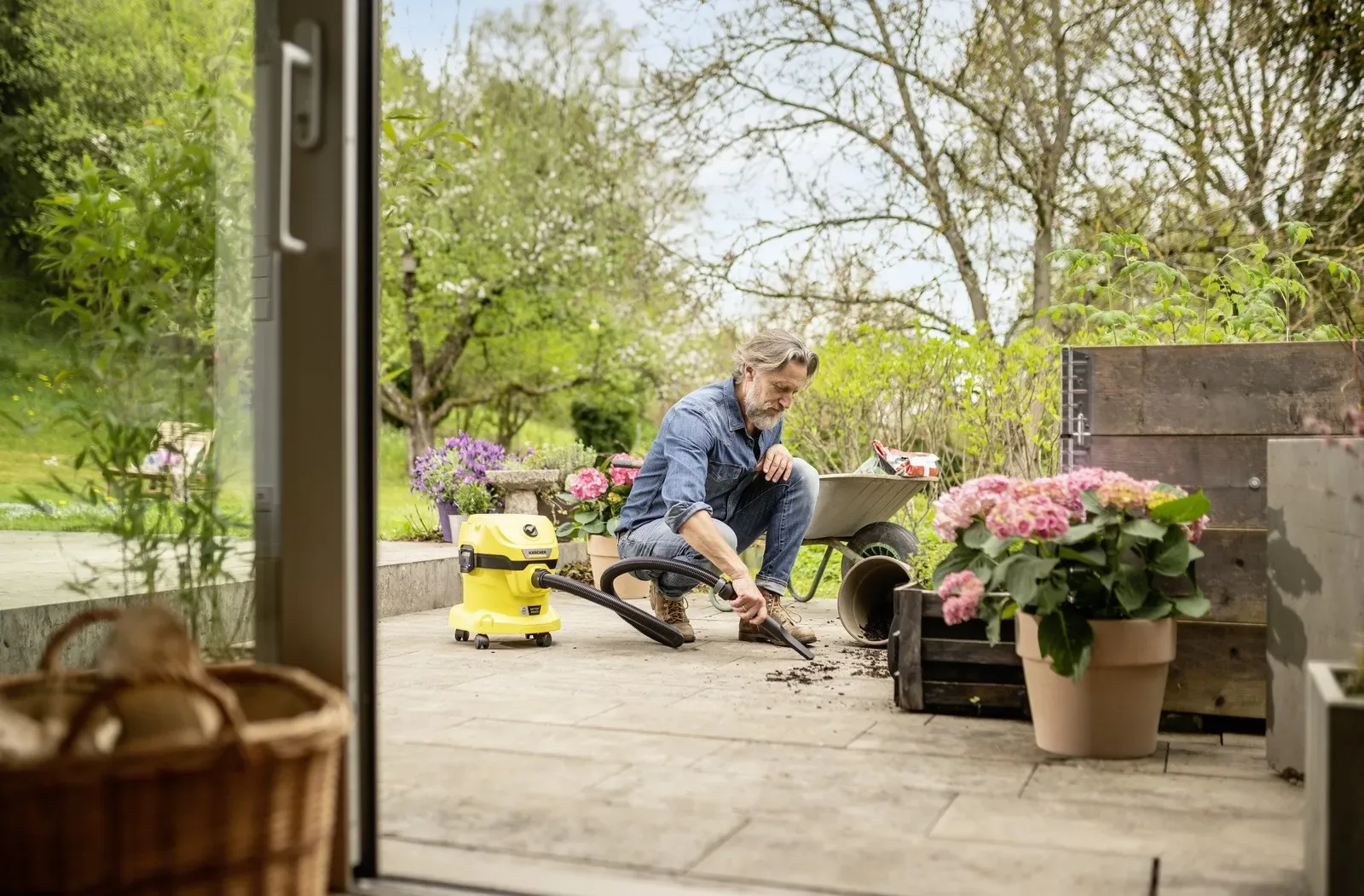
In the garden, a wet and dry vacuum is used for precision tasks rather than large areas:
- cleaning the top of pots and window boxes, removing dead leaves without pulling up the plants;
- emptying standing water from a saucer or a tray;
- collecting pruning debris from a path;
- cleaning a shed, a greenhouse or garden furniture.
For a lawn covered in leaves, a blower or a garden vacuum shredder is better suited. A wet and dry vacuum complements them; it does not replace them.
Paddling pool, aquarium, hot tub
- Paddling pool: you vacuum the bottom to remove leaves, insects and sand, and empty the remaining water. For a pool of several hundred litres, draining through the valve is quicker. With the optional adapter kit, the blower helps inflate it.
- Aquarium: vacuum slowly, with the fish and plants removed. Aquarium water empties easily with the tube.
- Inflatable hot tub: emptying the last few litres and cleaning the bottom.
- Garden pond: removing surface sludge, emptying often.
Uses of the blower
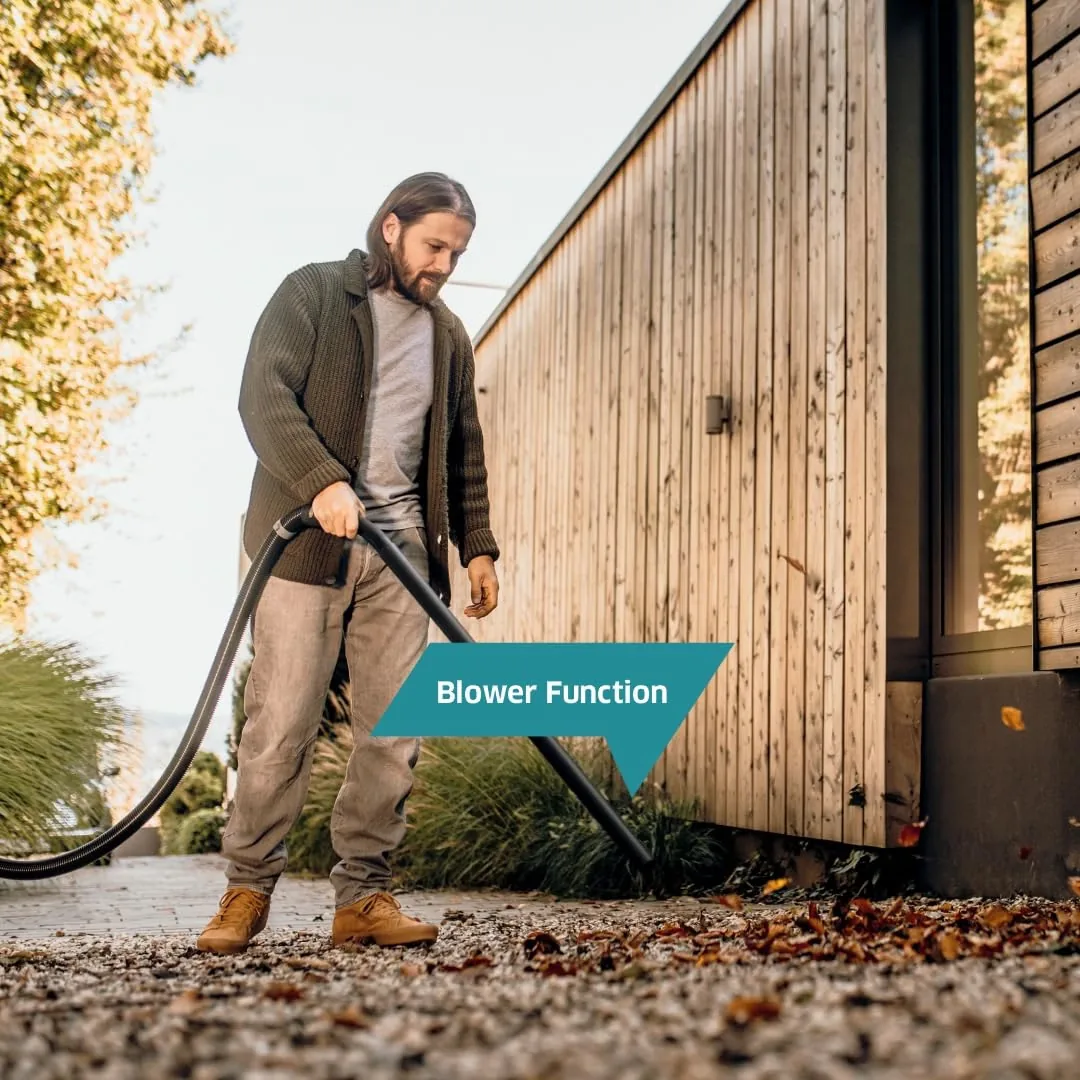
The blower function, present on the WD 3 V, turns the vacuum into a back-up blower. You connect the hose to the air outlet.
- chasing leaves out of the corners of a patio or a staircase;
- dusting a machine, a ventilation grille, a radiator, a workshop keyboard;
- quickly drying a surface after washing;
- inflating and deflating air mattresses and paddling pools, with the optional adapter kit.
Empty the tank before blowing if it contains fine dust, and wear goggles.
Inside the house
Indoors, a wet and dry vacuum helps out well on hard floors, concrete stairs, entrances and hobby rooms, which Kärcher lists among its areas of use. It is noisier than a household vacuum, less manoeuvrable, and its nozzles are not designed for thick rugs or delicate wooden floors.
It becomes unbeatable for big cleans: after moving house, before re-letting, after building work, or for an entrance where soil and gravel get brought in.
What you must not vacuum
- Ash and embers: Kärcher states that its wet and dry vacuums are not suitable for ash. Use an ash vacuum or a pre-separator.
- Flammable liquids: petrol, solvents, thinners, methylated spirits.
- Corrosive or toxic products: acids, concentrated chemicals.
- Hazardous dust: asbestos, lead.
- Large sharp objects that could puncture the hose.
Summary by use
| Use | Accessory | Bag | Point to watch |
|---|---|---|---|
| Leak, flood | Floor nozzle or tube | No | Empty when the float cuts out |
| Kitchen, broken glass | Floor nozzle | No if liquid | Rinse afterwards |
| Cellar, garage | Floor nozzle, crevice | Optional | Store somewhere dry |
| Workshop | Tube, crevice | Recommended | Empty often |
| Plaster, sanding | Tube, floor nozzle | Necessary | Change before saturation |
| Car | Crevice on the handle | No | Extension lead if needed |
| Patio | Floor nozzle, blower | No | No large stones |
| Garden, pots | Crevice, tube | No | Go gently on the plants |
Organising your tasks: the right order
When several tasks follow one another on the same day, the order matters as much as the set-up. A wet filter makes dust stick, and a tank full of mud is not the best starting point for sawdust. Here is the order that spares the appliance:
- Dry debris: car, garage, dry patio, workshop. Empty tank, dry filter.
- Fine dust: with a bag in place, dry filter.
- Emptying: throw away the bag, empty the tank.
- Wet tasks: wet leaves, mud, water. Without a bag.
- Rinsing and drying: tank, filter, nozzles.
If the water cannot wait, a leak for example, deal with it first, then rinse and dry the filter before returning to dry tasks. A second filter lets you carry on without waiting.
Moving house, inventories, spring cleaning
Moving house is one of the times when a wet and dry vacuum is most useful. Empty rooms reveal the dust built up behind the furniture, scraps of cardboard, fallen wall plugs and screws, and cobwebs in the corners.
- Floors: floor nozzle, in a single methodical pass, room by room.
- Skirting boards, window and wardrobe runners: crevice nozzle.
- Filled plug holes: a bag in place for the filler dust after sanding.
- Cellar and garage: often forgotten, they count for the check-out inventory too.
- Balcony and window boxes: soil, leaves and pollen.
The same applies to preparing a property for re-letting or sale, or a big spring clean. The large tank avoids frequent emptying, and the appliance’s toughness lets you pick up small building debris without worry.
Seasonal uses
In spring
Cleaning the garden furniture and patio after winter, picking up leaves left in corners, dusting the garden shed, preparing pots and window boxes.
In summer
Sand in the car after the beach, inflating mattresses and pools with the blower adapter, cleaning the bottom of a paddling pool, picking up insects and cobwebs in the garage.
In autumn
Dead leaves on the patio, in reachable gutters and light wells, rainwater in the garage, getting the cellar ready for winter.
In winter
Melted snow and salt in the car, water brought into the hallway, small indoor jobs, tidying the workshop. Remember: the vacuum must not pick up ash from the fireplace or the stove, which Kärcher advises against.
With pets
Households with pets find a wet and dry vacuum an ally for the jobs a household vacuum dreads:
- spilled cat litter: dry granules are picked up easily, empty quickly afterwards;
- a knocked-over water bowl: without a bag, with the floor nozzle;
- the basket or kennel: hair, soil and debris, with the crevice nozzle;
- the aquarium: partial draining and vacuuming the gravel, with the fish removed;
- the rabbit hutch or hen house: shavings and dry litter, with a bag for fine dust, and wearing a mask.
Empty and rinse the tank after these uses to avoid smells.
A typical year with a wet and dry vacuum
For a household with a house, garage, car and small garden, typical use looks like this:
| Frequency | Use |
|---|---|
| Every two to four weeks | Quick clean of the car |
| Every month | Garage and hallway, patio depending on the season |
| A few times a year | Small DIY jobs, with a bag |
| A few times a year | Big clean of the car, cellar or workshop |
| Unexpected | Water leak, broken glass, spilled liquid |
This is exactly the profile a compact appliance like the Kärcher WD 3 V-17/4/20 is designed for: taken out often, for short and varied tasks, and easily put away in between.
The limits of versatility
A wet and dry vacuum does a lot, but not everything:
- it does not wash floors or carpets: it picks up water, it does not shampoo;
- it does not replace a household vacuum for the comfort of everyday cleaning;
- it does not replace a blower or a garden vacuum shredder for a large lawn;
- it does not empty a flooded cellar as fast as a pump;
- it is not suitable for hazardous dust, which calls for certified appliances.
Knowing these limits lets you use it where it excels. Our guide how to choose helps you find the model suited to your uses.
Light professional uses
Without being a certified professional vacuum, an appliance like the WD 3 V is useful in many semi-professional settings:
- Small shops: shop entrance, stockroom, window display, after a delivery of boxes.
- Holiday lets: getting the place ready between stays, patio, barbecue cold and without ash, sand brought back from the beach.
- Clubs and associations: changing rooms, hobby rooms, storage spaces.
- Tradespeople for finishing: a last pass at the customer’s home after a small job, with a bag.
- Farms and rural workshops: sawdust, cobwebs, water in a plant room.
For daily, intensive use, or for dust subject to regulation, a professional vacuum of the appropriate class remains necessary.
Ten good practices for every use
- Adapt the filter set-up to what you are vacuuming.
- Do the dry work before the wet.
- Choose the nozzle for the task, or use the tube for coarse debris.
- Move slowly: the airflow does the work.
- Listen to the motor: a change of sound signals a problem.
- Switch off as soon as the float shuts off suction.
- Keep the plug and cable dry.
- Empty the tank after every use.
- Rinse and dry after every wet use.
- Never vacuum ash, flammable liquids or hazardous dust.
With these habits, a wet and dry vacuum covers almost all the needs of a house, a garage and a garden. Our maintenance guide complements this advice to keep it effective over time.
Five practical cases in detail
Putting up a shelf
Bag in place, drilling dust collector if you have one, or the tube held under the drill bit by a second person. Vacuum the dust after each hole, then make a final pass with the crevice nozzle along the skirting board.
A tin of water-based paint knocked over
Without a bag, immediately pick up most of the paint with the floor nozzle, then the rinse water. Rinse the tank, the filter and the nozzle thoroughly before the paint dries. For solvent-based paint, do not vacuum: it is flammable.
A gutter blocked with leaves
From a stable ladder, with a tube extension and the hose, pick up the leaves and debris without packing them down. Wet leaves are vacuumed without a bag. Never work alone at height.
A barbecue at the end of the season
Leave the ash alone: Kärcher advises against vacuuming it with its wet and dry vacuums. Only pick up the leaves, dust and cobwebs around the cold barbecue.
A Christmas tree
Fallen needles are picked up very well with the floor nozzle or the tube, including in corners where a household vacuum gets blocked. Empty the tank afterwards: needles take up a lot of room.
Which appliance for your uses
If your uses look like those in this guide, varied and occasional, an appliance with a cartridge filter and a 15 to 20 litre tank, with a blower and built-in storage, is the right choice. If the workshop or renovation dominate, go for a tool socket and filter cleaning. Our calculator points you in the right direction in a few questions, and our verdict on the WD 3 V details the profiles it suits.
The kit that goes with the vacuum
To get the full versatility of the appliance, a few simple extras make a difference: an extension lead suitable for outdoor use for the car and the garden, a pack of bags for building work, a second filter for switching between wet and dry, gloves and a mask for dusty jobs, and large bin bags for clean emptying. Stored with the vacuum, they turn a simple appliance into a real cleaning station ready at any moment. Our accessories guide details the compatible Kärcher options.
Getting started with your new vacuum
A new wet and dry vacuum is easier to master with a short tour of its uses. Begin with a dry, easy task such as the garage floor, to get used to the noise, the weight and the way the castors move. Then try the crevice nozzle in the car, fitted directly on the hose handle. Next, test the blower on a corner of the patio. Finally, spill a little water on a tiled floor, remove the bag and pick it up with the floor nozzle, listening to the motor so you recognise the sound of a full tank later. In half an hour, you will have tried every set-up in calm conditions, and you will react the right way on the day of a real leak or a big job. Keep the manual close by during this first tour: it answers most questions straight away.
Frequently asked questions
Can you vacuum mud?
Yes, without a bag, emptying often and rinsing the tank and filter afterwards.
Can you vacuum sand?
Yes. Fine sand behaves like fine dust: a bag helps keep the power up.
Can you vacuum wood shavings?
Yes, with the tube and no nozzle. Empty before the tank is full, as shavings take up a lot of room.
Can it replace a leaf blower?
For corners and small areas, yes. For a large lawn, a dedicated blower remains more effective.
Can you vacuum soapy water?
Yes, washing water is vacuumed without a bag. Rinse the tank afterwards to avoid deposits.
Cleaning without limits.
1000 W · 17 L tank · 2 m hose · 4 m cable · blower · cartridge filter. Prices change often on Amazon: check the price, the seller and the exact version (WD 3 V, WD 3 S, WD 3 P) before you order.
Check the price on AmazonAffiliate link · new tab