How to choose a wet and dry vacuum: the complete guide
Watts in big type, tanks of every size and model names that all look alike: wet and dry vacuum listings muddy the waters. Here are the criteria that really matter, with clear benchmarks, the traps to avoid and the right appliance for each use.
Contents
In brief: first choose the filter according to what you will vacuum (water, debris, fine dust), then check the real power (vacuum and airflow rather than watts), the tank, the length of the hose and cable, and the options you will really need: tool socket, filter cleaning, blower. For varied household use, an appliance with a cartridge filter and a 15 to 20 litre tank, such as the Kärcher WD 3 V-17/4/20, covers the essentials.
The four questions to ask first
Before comparing listings, answer four questions. They rule out half the models and stop you buying an appliance that is too basic or too big.
- What will you vacuum most often? Water and debris, sawdust, or very fine dust from plaster and sanding? The filter and the options depend on it.
- How often? A few times a year for emergencies, every weekend for DIY, or several days in a row during a renovation?
- Where will you use it? Garage, workshop, car, garden, cellar, inside the house? The length of the cable and hose, the accessories and the blower follow from this.
- Where will you store it? A 30-litre tank takes up room. A compact appliance that is easy to get out will be used more often.
These answers define your profile. Our calculator turns your use directly into a recommendation.
Criterion 1: the filter
The filter is the heart of a wet and dry vacuum. It protects the motor, determines the quality of the air that comes back out and decides whether the appliance keeps its power on fine dust. Three technologies share the consumer market.
| Filter type | Strengths | Limitations | For whom |
|---|---|---|---|
| Foam filter | Simple, ideal for water | Bag mandatory for dust, must be changed between dry and wet on some models | Occasional emergencies |
| Cartridge filter | Wet and dry without a change | Clogs quickly on fine dust without a bag | Varied household use |
| Pleated flat filter | Quick removal, large surface, often combined with filter cleaning | More expensive models | Regular DIYers, renovation |
At Kärcher, the rules are documented: foam filter models (WD 2) must always be used with a bag for dust, and on WD 3 to WD 6 models, with a cartridge or flat filter, the bag is necessary for fine dust. For liquids, Kärcher recommends vacuuming without a bag.
The filter bag plays a double role. It captures fine dust before it reaches the main filter, which keeps the power up for longer. And it makes emptying clean: you throw away the closed bag instead of emptying a tank that releases a cloud of dust. If you plan any building work, the cost of bags is part of the budget.
A final point concerns hazardous dust. Consumer wet and dry vacuums are not certified for asbestos or other hazardous dust, which call for class H professional vacuums and specific procedures. Our filter guide goes into each case.
Criterion 2: real power
Power is the most misunderstood criterion. Listings display watts in big type, but this figure measures electricity consumption, not suction efficiency.
Four values describe the power of a wet and dry vacuum:
- power input, in watts: the motor’s consumption;
- suction power, in watts (often called “air watts”): the power transferred to the air;
- vacuum, in millibars (mbar) or kilopascals (kPa): the maximum suction force;
- airflow, in litres per second (l/s): the volume of air moved.
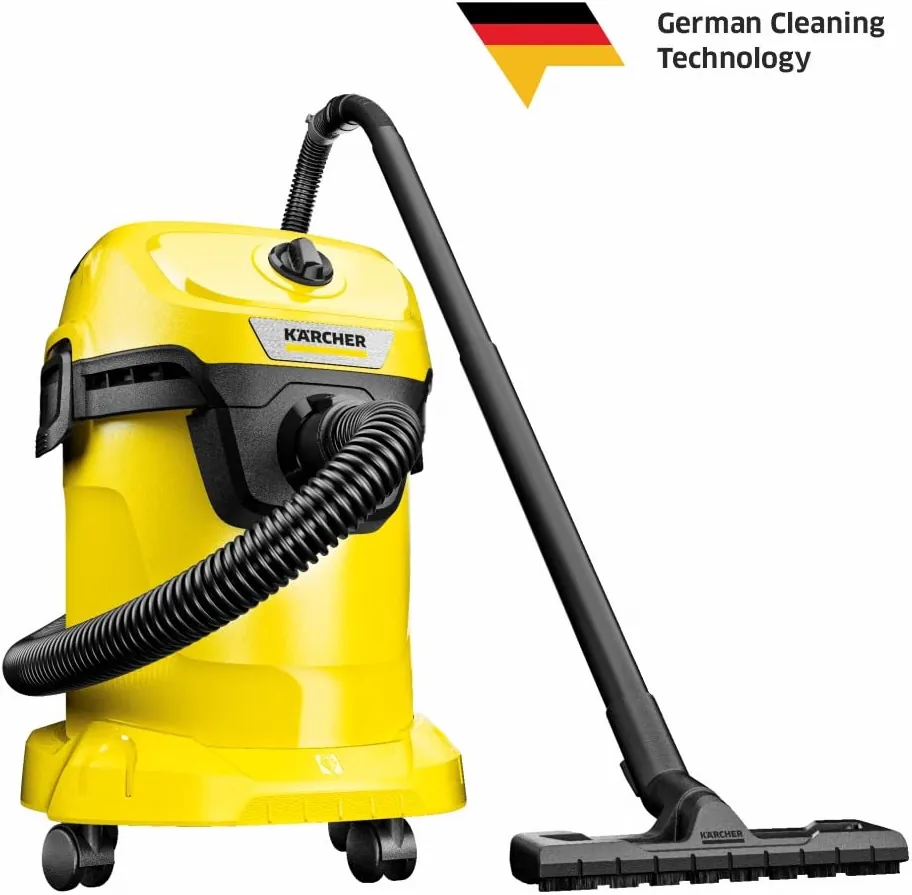
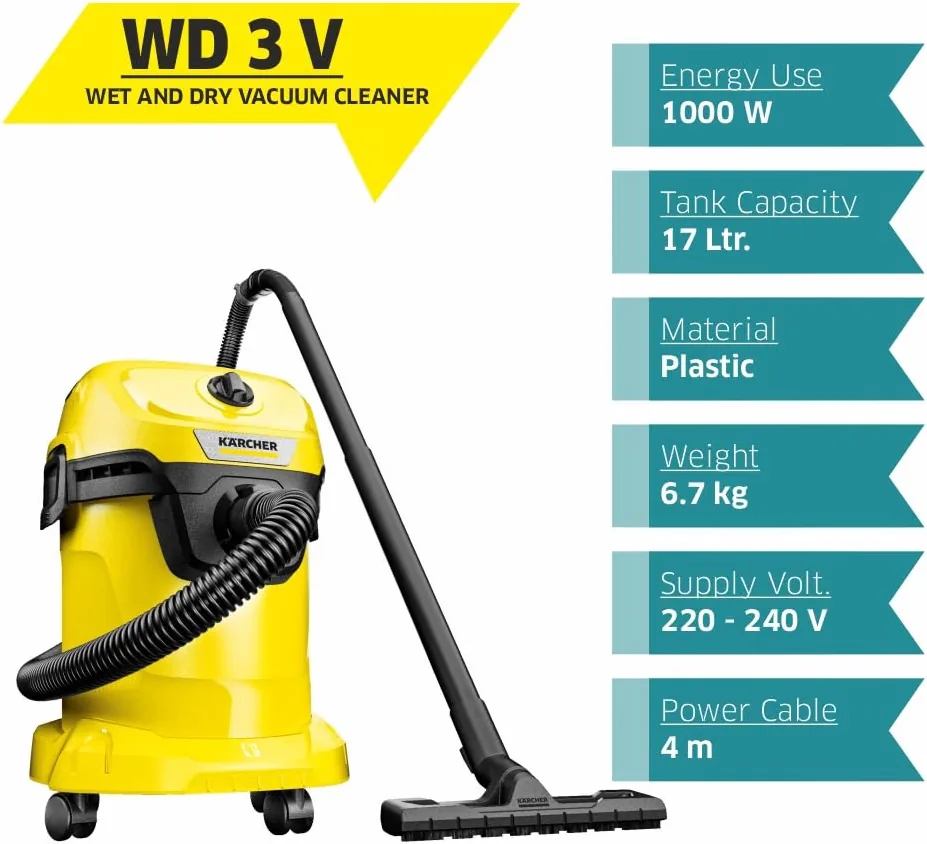
Vacuum matters for lifting heavy debris and picking up water. Airflow matters for quickly collecting light debris such as leaves and sawdust. A good appliance combines both. For the Kärcher WD 3 V-17/4/20, Kärcher quotes 1000 W power input, 230 W suction power, 230 mbar and 45 l/s maximum.
These values are measured by manufacturers using their own methods: they compare well within a range, less well from one brand to another. Independent tests remain the best reference. The magazine Auto Zeitung, for example, rated the suction power of the WD 3 S V-17/4/20 version as high and close to the best in its comparison. Our article watts, millibars and airflow explains these units in detail.
Power control is a plus, rarely essential. It helps when vacuuming light fabrics without them sticking to the nozzle, or to reduce noise. The WD 3 V does not have it, as Auto Zeitung notes.
Criterion 3: the tank
The tank determines how much you can pick up before emptying. A bigger one means fewer emptyings, but the appliance becomes heavier and bulkier, and a tank full of water becomes hard to carry.
| Capacity | Typical use | Point to watch |
|---|---|---|
| 10 to 15 L | Flat, car, small emergencies | Frequent emptying |
| 15 to 20 L | Varied household use | Good balance of volume and handling |
| 25 to 30 L | Renovation, big jobs, large cellars | Heavy when full of water, bulky |
There are two materials. Plastic is light, does not rust and keeps the price down. Stainless steel resists knocks better, is easier to clean and ages better in appearance. Suction does not change with the material: at Kärcher, the WD 3 V and the WD 3 S share the same motor, filter and accessories.
Bear in mind that the usable volume for water is below the nominal volume: the float closes off suction before the water reaches the filter. Also look at the castors, the bumper and how easily the head opens.
Criterion 4: the hose and tubes
The hose determines both what you can pick up and how comfortable the appliance is to use.
- Diameter: 32 to 36 mm on consumer models. A wider hose swallows bigger debris and blocks less. The WD 3 V has a 35 mm hose.
- Length: 1.5 to 2.5 m in most cases. A longer hose lets you leave the appliance on the ground while you vacuum a staircase or the inside of a car.
- Removable handle: it lets you fit the nozzles directly onto the hose, without a tube, for corners.
- Tubes: plastic or metal, they let you vacuum standing up. Two 0.5 m tubes are standard.
A hose extension is often available as an accessory. At Kärcher, a 3.5 m extension is offered for the WD range.
Criterion 5: the cable and reach
The cable measures 4 to 6 m on most consumer appliances. Added to the hose and tubes, it gives the reach without an extension lead. With a 4 m cable, a 2 m hose and two tubes, the WD 3 V-17/4/20 reaches about 7 m around the socket.
That is enough for a room, a garage or a car parked in front of the house. For a large garden or a cellar far from any socket, plan for an extension lead of sufficient cross-section, suitable for outdoor use if needed. At Kärcher, the middle number in the model name shows the cable length: /4/ for 4 m, /6/ for 6 m.
Criterion 6: the tool socket
Some vacuums have an electrical socket into which you plug a tool: sander, saw, planer, wall chaser. The vacuum starts automatically when the tool starts and stops a few seconds after it. The tool is linked to the vacuum by a suitable hose, and the dust is extracted at source.
This is a real comfort if you sand or saw regularly: less dust in the air, a cleaner surface, better visibility. For occasional use, vacuuming afterwards is enough. At Kärcher, the letter P in the model name (WD 3 P, WD 4 P, WD 5 P, WD 6 P) signals this socket. The WD 3 V does not have one.
Criterion 7: filter cleaning
Filter cleaning is a system that cleans the filter without opening the tank: at the push of a button, a reverse airflow or a shake knocks off the dust built up on the filter. Power comes back within seconds.
On a sanding or plastering job lasting several hours, it is the feature that changes everything: without it, you have to stop, open the tank and clean the filter as soon as suction weakens. For varied household use, its absence is not a problem, especially with a bag. At Kärcher, filter cleaning is found on the WD 5 and WD 6 models.
Criterion 8: the blower
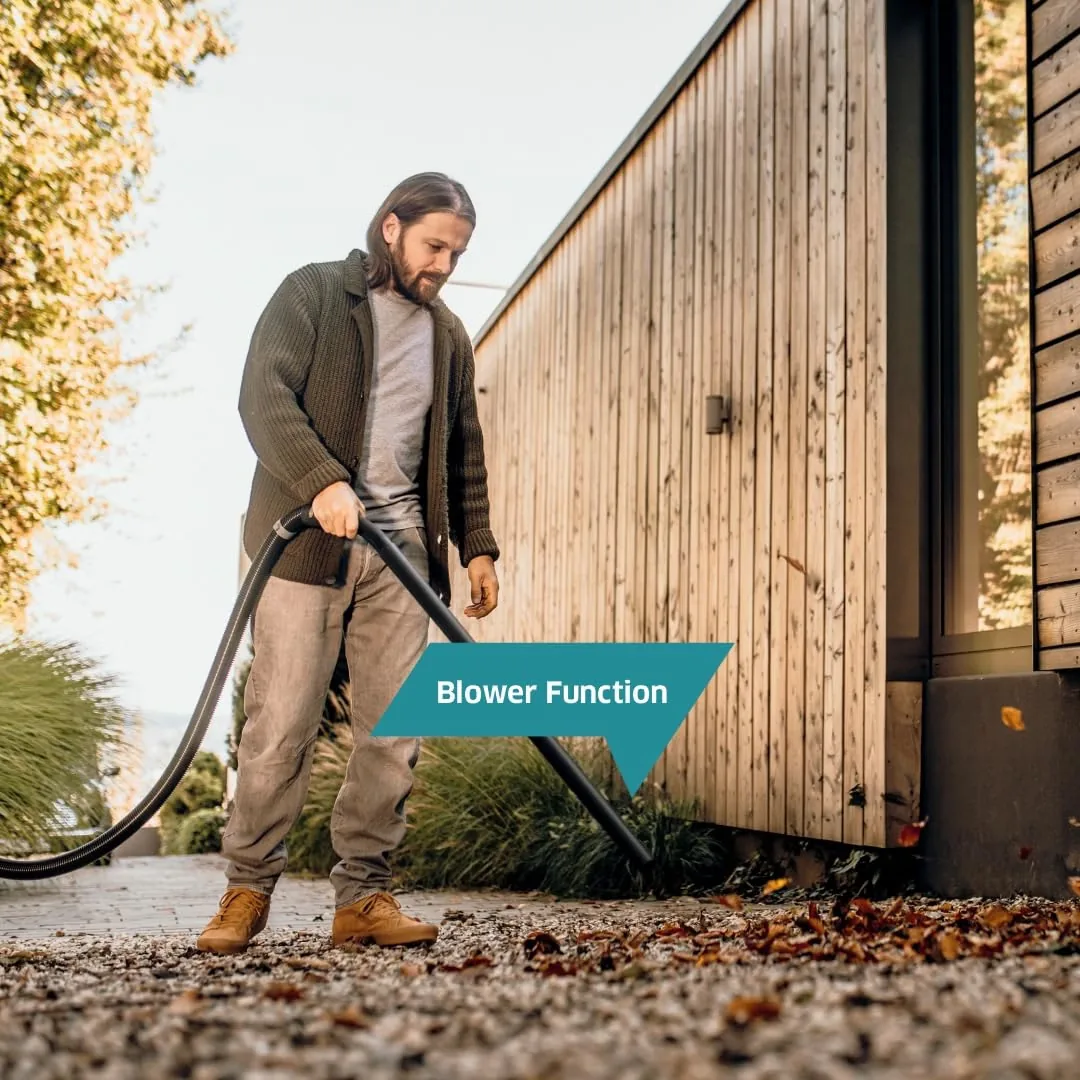
The blower involves connecting the hose to the appliance’s air outlet to blow rather than suck. It is used to chase leaves out of the corners of a patio, to dust a machine, a grille or a workshop shelf, and, with an adapter, to inflate mattresses and paddling pools.
It does not replace a garden blower for a large lawn, but it does plenty of useful jobs at no extra cost. Most mid-range models have one, including the WD 3 V.
Criterion 9: the accessories
The accessories supplied and the availability of optional ones weigh heavily in use. At the very least, check for:
- a wet and dry floor nozzle, ideally with rubber strips for water and brushes for dust;
- a crevice nozzle for corners and the car;
- two tubes;
- a filter bag, and the reference of the spare bags.
For options, check whether the brand offers car kits, hose and tube extensions, specific nozzles and a tool kit. A widespread range such as Kärcher’s WD has the advantage of offering a wide choice of accessories and consumables that are easy to find. Our accessories guide details which ones are worth it.
Criterion 10: noise, weight and storage
A wet and dry vacuum is noisy by nature: most consumer models are between 70 and 80 dB(A) according to manufacturers. Kärcher quotes 74 dB(A) for the WD 3 V. For a long job, ear protection is useful.
Weight matters when you carry the appliance up a staircase or empty a full tank. A 17 L model like the WD 3 V weighs 4.5 kg empty according to Kärcher; 25 to 30 L models often exceed 7 to 9 kg.
Storage makes the difference day to day: an appliance that stores its hose, cable and accessories on itself can be got out and put away in seconds. It is a detail that often decides whether the appliance gets used or stays at the back of the garage.
The traps in product listings
- Watts in big type: they measure consumption. Look for suction power, vacuum and airflow.
- “kPa” and “Pa” that cannot be compared: measurement methods differ between brands. Prefer independent tests.
- Nominal capacity: the usable volume for water is lower.
- “Included” accessories: some listings show photos of optional kits. Read the list of contents.
- Similar variants: V, S, P, /4/, /6/ denote different appliances. Check the exact reference.
- A “HEPA filter” on a consumer appliance: it is not a certification for hazardous dust.
The right appliance for each profile
| Profile | What you need | Example at Kärcher |
|---|---|---|
| Occasional emergencies, small home | Small tank, simple filter | WD 2 |
| House with garage, car and garden | 15 to 20 L, cartridge filter, blower | WD 3 V |
| DIYer who sands or saws often | Tool socket | WD 3 P |
| Renovation, plaster, long jobs | Flat filter, filter cleaning, big tank | WD 5, WD 6 |
| Flood-prone cellar, large amounts of water | Medium tank and easy emptying, or a pump | WD 3 V or a model with a drain |
For most households, the ideal combination remains a household vacuum for routine cleaning and a wet and dry vacuum for everything else. Our guide to all the uses details how the roles are shared.
Is the WD 3 V right for you?
Answer a few questions: we tell you whether the Kärcher WD 3 V-17/4/20 suits you, how to set it up (with or without a filter bag) and how many times to empty it for a given volume of water.
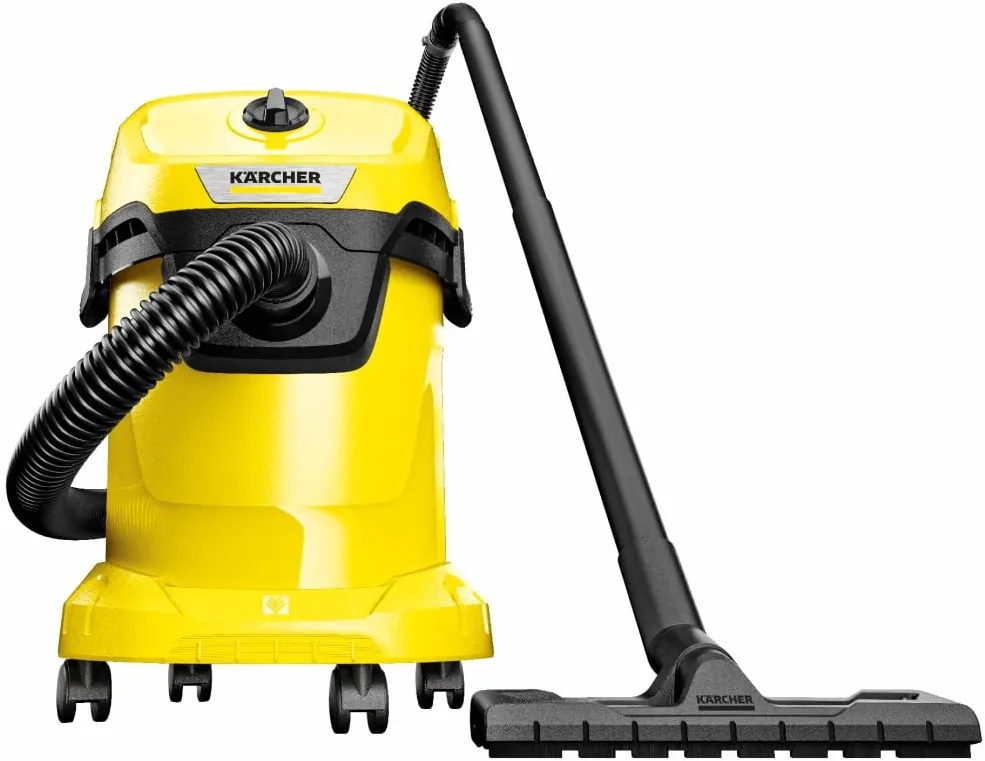
1000 W, a 17 L tank, a cartridge filter for water and dust, a blower and a compact 4.5 kg format: the essentials for home, workshop and car.
- 1000 W
- 17 L
- Blower
Reading a range: the Kärcher WD example
Kärcher’s WD range is one of the most widespread, and its naming system illustrates the criteria above well.
- WD 2: foam filter, bag mandatory for dust.
- WD 3: cartridge filter, wet and dry without a change, blower. Letter V for the plastic tank, S for the stainless steel tank, P for the tool socket.
- WD 4 to WD 6: flat filter, and filter cleaning on the WD 5 and WD 6.
The numbers that follow give the tank capacity, the cable length and the hose length. The WD 3 V-17/4/20 is therefore a WD 3 with a 17 L plastic tank, a 4 m cable and a 2 m hose.
Our pick for most households
For varied household use, we recommend the Kärcher WD 3 V-17/4/20. It ticks the essential boxes: a cartridge filter for wet and dry, suction rated high by Auto Zeitung, a 17 L tank for 4.5 kg, a blower and built-in storage. It is not suited to intensive sanding jobs: no filter cleaning, no tool socket, no power control.
The pre-purchase checklist
- I have identified what I will vacuum most often: water, debris, fine dust.
- I have chosen the right type of filter.
- I have compared suction power, vacuum and airflow, not just watts.
- The tank capacity matches my volumes and my strength for emptying it.
- The cable and hose cover my working area, or I have planned an extension.
- I know whether I need a tool socket and filter cleaning.
- The accessories included cover my uses, and spare bags are easy to find.
- I have checked the exact model reference, the plug and the seller.
- I have somewhere to store the appliance.
Durability, parts and after-sales service
A wet and dry vacuum lasts a long time if it is well looked after, as long as consumables and parts remain available. Before buying, look beyond the appliance itself:
- Consumables: filters and bags must be easy to find, from the manufacturer, its dealers and online. A very widespread range such as Kärcher’s WD offers a real advantage here.
- Wear parts: castors, seals, float, hose. A manufacturer with a dealer network and a repair service lets you keep the appliance going.
- The guarantee: two years is common for the WD range according to retailer listings, on top of your statutory rights.
- The design: a tank with a bumper, a solid lock and a flexible hose stand up better to knocks in the garage.
Little-known brands sold cheaply often have a consumables problem: a filter that cannot be found after two years makes the appliance unusable.
The most common buying mistakes
- Choosing the biggest tank on principle, and ending up with a bulky appliance you never get out.
- Choosing on the watts displayed, without looking at suction power, vacuum and airflow.
- Forgetting the bags: without them, fine dust clogs the filter and the appliance seems weak.
- Paying for a tool socket you will never use, or forgetting it when you sand every weekend.
- Overlooking the length of the cable and hose, then discovering the car is too far from the socket.
- Mixing up two versions of the same model with similar names.
- Expecting a wet and dry vacuum to offer the comfort of a household vacuum for everyday cleaning.
Each of these mistakes is put right by rereading the four questions at the start of this guide: what, how often, where, and where to store it.
Buying on Amazon: the checks
Amazon offers a wide choice of wet and dry vacuums, with many variants of the same model. A few checks avoid unpleasant surprises:
- The listing title must mention the exact reference, for example WD 3 V-17/4/20.
- The list of contents must match the accessories you expect: hose, tubes, nozzles, filter, number of bags.
- The plug must match your country’s sockets.
- The seller: Amazon or a third-party seller, with its own return conditions.
- The reviews: read recent, detailed reviews and look for trends rather than isolated cases.
- The photos: some show optional accessories that are not included.
In the UK, the Consumer Contracts Regulations give you 14 days to cancel an online purchase, and the Consumer Rights Act protects you if the goods are faulty.
Where to put your budget
For household use, a well-designed mid-range appliance plus a stock of consumables is better than a high-end appliance whose features you will not use. In order, our priorities are:
- a filter suited to your uses, cartridge or flat;
- decent power, confirmed by independent tests;
- consumables that are easy to find, and a pack of bags from day one;
- the options that are really useful to you: tool socket, filter cleaning, stainless steel tank;
- accessories specific to your uses, such as a car kit or a hose extension.
Appliance prices change often: compare over a few days before buying, always checking the exact reference.
Building your own comparison grid
When two or three models are still in the running, a simple grid helps you decide. Score each criterion according to how important it is to you, rather than according to the product listing:
| Criterion | Question to ask yourself | Weight for varied household use |
|---|---|---|
| Filter | Can I switch from dry to wet without dismantling? | High |
| Power | Do independent tests rate it as good? | High |
| Tank | Does its capacity match my volumes? | Medium |
| Hose and cable | Do they cover my area without an extension? | Medium |
| Tool socket | Will I really plug in a tool? | Low, except for regular DIYers |
| Filter cleaning | Will I sand for several hours at a stretch? | Low, except for renovation |
| Consumables | Are filters and bags easy to find? | High |
| Storage | Where will I store it, and does it store its accessories? | Medium |
This grid stops you overpaying for a useless option or overlooking a criterion that will make a difference every week.
Three real-life scenarios
The owner of a house with a garden
They vacuum the car once a month, the patio leaves in autumn, the cellar after a storm and drill a few holes a year. A 17 to 20 litre appliance with a cartridge filter and a blower covers everything. A pack of bags and, possibly, a hose extension complete the kit.
The weekend DIYer
They sand, saw and drill almost every week. The tool socket, which starts the vacuum with the sander, changes their working comfort. A cartridge filter with bags is enough if sessions stay short; for long sanding sessions, a flat filter with filter cleaning will hold up better.
The family renovating their house
Plaster, filler, tiling, knocking down partitions: dust is a daily fact for weeks. A 25 to 30 litre model with filter cleaning and a tool socket is justified. It can then serve in the garage, even if it is bulkier.
The choice in one sentence
Choose the filter according to what you vacuum, the power according to tests rather than watts, the tank according to your volumes and your storage space, and only add options if you will use them: that is how you find the appliance you actually get out.
The first week after buying
The right choice is confirmed in the first few days of use. When the appliance arrives, check the contents against the listing: hose, tubes, nozzles, cartridge filter and bag. Assemble it, unwind the cable fully and try each set-up on a simple task: dry debris in the garage, a little water on a hard floor, the car seats with the crevice nozzle. Note what is missing for your uses, perhaps a longer hose for the stairs or spare bags for a planned job, and order it before you need it. Finally, keep the packaging and the receipt during the return period: if the appliance does not suit you, returning it is much simpler within that window. This small trial run turns a purchase into a tool you know how to use when the leak or the job actually happens.
Frequently asked questions
How powerful should a wet and dry vacuum be?
For household use, an appliance around 1000 W power input with a vacuum of about 200 mbar and an airflow around 40 l/s does the job. Above all, compare suction power and independent tests.
Cartridge filter or flat filter?
A cartridge suits varied use. A flat filter, often combined with filter cleaning, is better for frequent fine dust.
Do you need a stainless steel tank?
No, it does not suck better. It resists knocks better and is easier to clean.
What capacity should you choose?
15 to 20 L for most households, 25 to 30 L for big jobs.
Is a tool socket essential?
Only if you sand or saw often.
Can a wet and dry vacuum pick up asbestos?
No. Asbestos calls for certified professional vacuums and regulated procedures.
Cleaning without limits.
1000 W · 17 L tank · 2 m hose · 4 m cable · blower · cartridge filter. Prices change often on Amazon: check the price, the seller and the exact version (WD 3 V, WD 3 S, WD 3 P) before you order.
Check the price on AmazonAffiliate link · new tab