Wet and dry vacuum filters: cartridge, flat filter and bag
The filter decides whether your wet and dry vacuum keeps its power or runs out of breath after five minutes of sanding. Here is how each type of filter works, when to add a bag, and how to look after it.
Contents
In brief: on a wet and dry vacuum with a cartridge filter like the Kärcher WD 3, the filter stays in place for wet and dry work. Add a bag for fine dust, remove it for water. Clean the filter under running water without rubbing, and let it dry completely before using it on dust.
The role of the filter
In a wet and dry vacuum, air comes in through the hose, crosses the tank where heavy debris and water settle, then passes through the filter before reaching the motor and leaving. The filter has three jobs:
- protecting the motor from dust, which would wear it out prematurely;
- catching fine dust so that it is not blown back into the room;
- letting the air through as freely as possible, to keep the power up.
These jobs partly conflict. A very fine filter catches dust better but clogs faster. A more open filter lets air through better but blows out more dust. Each technology is a compromise, and the filter bag often complements the main filter.
The foam filter
The foam filter is fitted to the simplest models. It works well for picking up water, but catches fine dust poorly. At Kärcher, foam filter models (WD 2) must always be used with a bag to vacuum dust.
On some appliances from other brands, you even have to change the filter between dry and wet vacuuming, which complicates matters when tasks follow one another.
The cartridge filter
The cartridge filter is a cylinder of pleated paper or synthetic fibres, fixed under the head of the appliance. Its pleats offer a large filtering surface in a small volume.
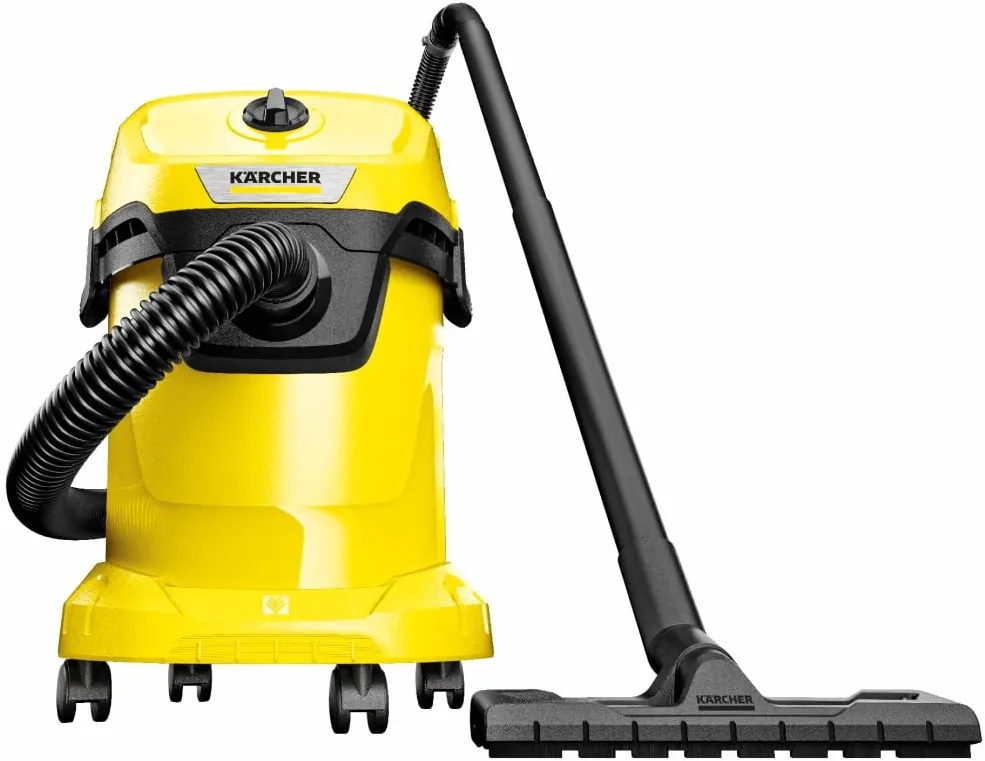
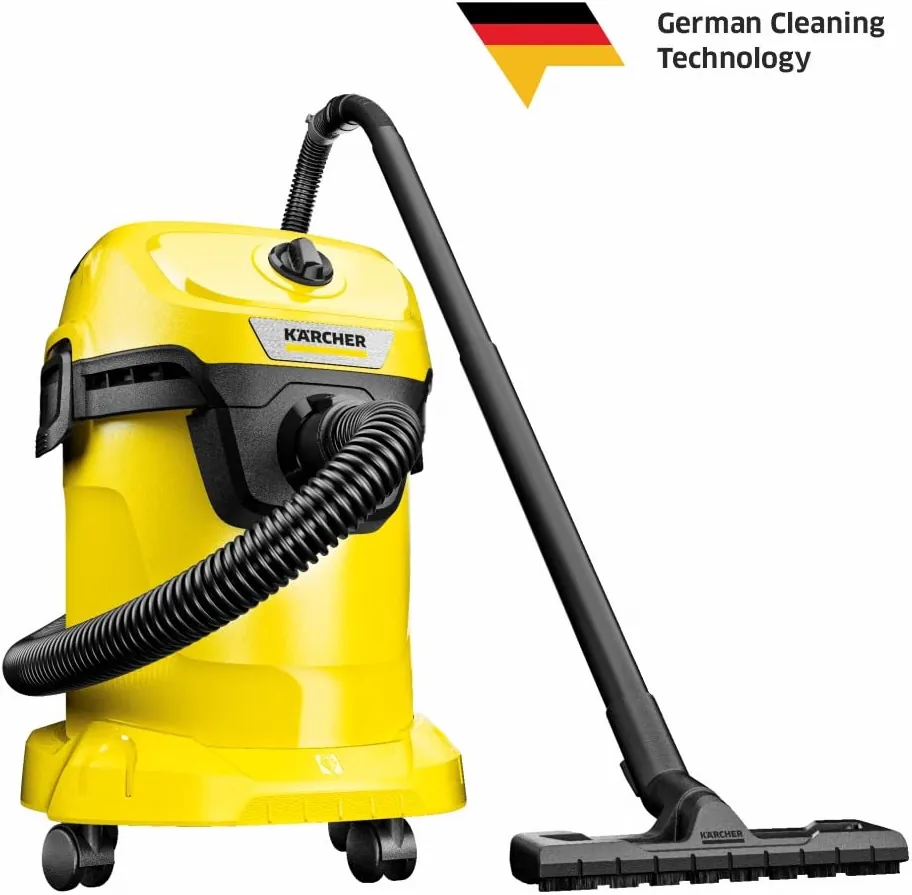
Its great advantage: it stays in place for wet and dry vacuuming alike. This is the case on the Kärcher WD 3, whose Amazon listing stresses that it can vacuum wet and dry dust without having to change the filter.
Its limitation: without protection, it clogs quickly on very fine dust (plaster, sanding, cement), which gets lodged in the pleats. For this type of dust, Kärcher considers the bag necessary on WD 3 to WD 6 models.
The pleated flat filter
The pleated flat filter sits flat in the head and comes out in a few seconds, without opening the tank on some models. It is generally fitted to mid-range and higher models, at Kärcher from the WD 4 upwards.
Its strengths: quick replacement, a large filtering surface and the possibility of effective filter cleaning. Like the cartridge, it benefits from being protected by a bag for fine dust.
Filter cleaning
Filter cleaning cleans the filter without opening the appliance. Depending on the model, a button sends a reverse airflow through the filter, or shakes it mechanically. The dust drops into the tank, the air flows freely again, and the power comes back.
This is the feature that makes the difference on a long sanding or plastering job. At Kärcher, it is found on the WD 5 and WD 6. The WD 3 does not have it: you have to open the tank and clean the filter when suction weakens, which remains rare with a bag in place.
The filter bag
The filter bag, made of fleece or paper, is fixed inside the tank over the suction opening. It captures dust at the inlet, before it reaches the main filter.
- It keeps the power up: the main filter stays clean for longer.
- It makes emptying clean: you throw away the closed bag, with no cloud of dust.
- It protects the tank: fine dust does not become embedded in the plastic.
It also has constraints. It is removed for water: Kärcher recommends vacuuming liquids without a bag, as it would soak up water and could tear. And it is a consumable: the WD 3 V’s Amazon listing mentions a single bag supplied, and buyers advise ordering more at the time of purchase. Bags for the WD 3 range carry the reference 2.863-314.0 according to Kärcher’s data sheet.
Which set-up for which use
| What you are vacuuming | Main filter | Bag | Note |
|---|---|---|---|
| Clean or dirty water | In place | Removed | Empty when the float cuts out |
| Mud, wet leaves | In place | Removed | Rinse the tank and filter afterwards |
| Dry debris, soil, gravel | In place, dry | Optional | Empty the tank directly |
| Sawdust, shavings | In place, dry | Recommended | Shavings fill the tank quickly |
| Plaster, sanding, cement | In place, dry | Necessary | Change before it is saturated |
| Ash | Not to be used according to Kärcher: use an ash vacuum or a pre-separator | ||
The golden rule: the filter must be dry for dust. After picking up water, let it dry completely, or organise your tasks to do the dry work before the wet.
Cleaning the filter
Kärcher gives a precise instruction for its filters: rinse them under running water, without rubbing or brushing them, and let them dry completely.
- Unplug the appliance and open the tank.
- Remove the filter and tap it gently over a bin, preferably outdoors.
- Rinse it under a stream of water, without rubbing or using a brush: the fibres would be damaged and let dust through.
- Leave it to dry in the open air for several hours, without putting it on a radiator or using a hairdryer.
- Refit it, checking that it is properly seated with no play.
Avoid using a compressed-air gun at close range: it can puncture the fibres. And do not use harsh detergents. Having a second filter lets you keep working while the first one dries.

When to replace the filter
- The filter is torn, punctured or misshapen.
- Traces of dust appear at the air outlet or on the motor.
- Suction does not come back after a full rinse and drying.
- The filter keeps a persistent smell despite rinsing.
No lifespan is published: it depends on use. A filter used mainly for water and debris lasts a long time; a filter often exposed to fine dust without a bag wears out much faster. The cartridge for the WD 3 range carries the reference 2.863-303.0 according to Kärcher.
Hazardous dust: the limits
Consumer wet and dry vacuums are not designed for hazardous dust. Professional vacuums are classed L, M or H according to their ability to retain increasingly hazardous dust. Asbestos, in particular, calls for class H appliances and regulated procedures carried out by professionals.
For hardwood, concrete or silica dust, a consumer appliance with a bag limits exposure without eliminating it: wear a suitable mask and ventilate. A “HEPA” label on a consumer appliance is not a class certification.
The Kärcher WD 3 V’s filter
The Kärcher WD 3 V-17/4/20 comes with a one-piece cartridge filter and a fleece filter bag. The filter stays in place for wet and dry work. It has no filter cleaning. Used correctly, with a bag for fine dust and no bag for water, it keeps its power. Buyer reviews that mention a rapid loss of power almost always describe vacuuming fine dust without a bag.
Signs of a clogged filter
A clogged filter is easy to spot, as long as you know what to look for:
- the motor sound changes and becomes higher-pitched, even though the tank is not full;
- suction weakens noticeably at the end of the hose, even without a nozzle;
- dust stays on the floor after a pass that should have been enough;
- the filter surface is grey or white, covered with a compact layer of dust;
- the head gets hotter than usual, because the motor is straining.
Before blaming the filter, do a quick test: remove the hose and switch the appliance on. If suction is strong at the tank opening, the problem lies in the hose or the nozzle. If it stays weak, it is the filter or the bag. This diagnosis takes ten seconds and saves dismantling for nothing.
Organising a job to spare the filter
On a DIY job, a few simple habits keep the power up from start to finish:
- Fit the bag before you start, not when the filter is already loaded.
- Collect the coarse debris first by hand or with a shovel: offcuts, lumps of plaster, screws. The vacuum keeps its tank for the dust.
- Vacuum as you go, after each drilling or sanding session, rather than all at once at the end.
- Tap the filter at every break, over a bin, to knock off the surface layer.
- Do the dry work before the wet: a wet filter makes dust stick.
- Keep a second, dry filter to hand on long jobs.
On an appliance without filter cleaning like the WD 3 V, these habits more than make up for the lack of an automatic cleaning button on a household job.
Filter and the quality of exhaust air
All the air that is sucked in comes back out through the appliance’s air outlet. Whatever the bag and filter have not caught is blown back into the room. With a clean, properly fitted filter, and a bag for fine dust, the amount blown out stays small. With a punctured, badly positioned or missing filter, fine dust passes through and settles everywhere.
Three precautions limit the dust blown out: check that the filter is properly fitted with no play, use the bag for all fine dust, and point the air outlet away from yourself. For dusty work indoors, ventilate the room and wear a suitable mask, even with a well set-up vacuum.
Filter myths
- “The filter is cleaned with a brush.” No: Kärcher says to rinse it under running water, without rubbing or brushing, so as not to damage the fibres.
- “The bag is for perfectionists.” For fine dust, it is necessary on the WD 3 to WD 6 according to Kärcher.
- “You keep the bag in for water.” No: liquids are vacuumed without a bag.
- “A damp filter works just as well.” For water, yes. For dust, it blocks immediately.
- “A filter should be changed every month.” There is no fixed frequency: you replace it when it is damaged or no longer lets air through properly.
Choosing a vacuum by its filter
If you have not bought your appliance yet, the filter is a good starting point:
- You mainly pick up water and debris, and rarely dust: a cartridge filter is plenty, and even a foam filter with a bag for small emergencies.
- You often alternate dry and wet: the cartridge filter, which stays in place, is the most practical.
- You do DIY regularly: a cartridge filter with bags, or a flat filter.
- You renovate, sand, fill: a flat filter with filter cleaning will hold its power better over the hours.
Think about running costs too: bags and spare filters are part of the budget. A widespread range guarantees consumables that are easy to find. Our guide how to choose puts the filter in context with the other criteria.
The running cost of filters and bags
The purchase price of a wet and dry vacuum does not tell the whole story: consumables count too. For mainly wet and emergency use, the cartridge filter lasts a long time and bags are rarely used. For regular workshop use, bags become an item of expenditure to plan for, and a spare filter wears out faster. Used properly, the bag extends the life of the main filter: one expense that avoids another. Prices change often: compare multi-packs of bags rather than single bags.
Storing spare filters and bags
Spare filters and bags keep for a long time if they are stored properly. Keep them in their packaging, somewhere dry, away from damp and direct sunlight, which can weaken paper and fleece. A clean, dry spare cartridge stored next to the vacuum lets you swap filters in seconds when the first one is soaked after picking up water. Bags should not be crushed or folded at the collar, which must stay flat to seal well against the suction opening. Finally, label any filter you have rinsed with the date: it helps you see how long it lasts with your use.
Frequently asked questions
Can you use the vacuum without a filter?
No. The filter protects the motor. Without it, dust and water would damage it.
Can you wash the filter in the dishwasher?
Kärcher recommends rinsing under running water, without rubbing or brushing. The dishwasher is not intended for this.
Is the bag reusable?
No, it is thrown away when full. Reusable bags exist from some brands, but not in Kärcher’s standard WD range.
Why does dust come out of the back?
The filter is badly fitted, punctured or missing. Check it before carrying on.
Do you need a bag for sawdust?
It is advisable for fine sawdust. For large shavings, the filter alone is enough, as long as you empty often.
Cleaning without limits.
1000 W · 17 L tank · 2 m hose · 4 m cable · blower · cartridge filter. Prices change often on Amazon: check the price, the seller and the exact version (WD 3 V, WD 3 S, WD 3 P) before you order.
Check the price on AmazonAffiliate link · new tab