Kärcher WD 3 V-17/4/20 review: what it does well, and less well
A 4.5 kg wet and dry vacuum with a 17-litre tank, a cartridge filter that switches from dry to wet without dismantling anything, and a blower outlet. We cross-checked the spec sheet, published tests and buyer feedback to find out who it suits.
Contents
Our method: this review is based on Kärcher France’s product page and FAQ, the technical data sheet for the WD 3 range (reference 1.628-101.0), the Amazon listing for the WD 3 V-17/4/20, the comparison published by the German magazine Auto Zeitung on the WD 3 S V-17/4/20 version, the listings of major retailers, and an analysis of buyer reviews, summarised without being copied. We did not receive the appliance from the brand.
The verdict in brief
The Kärcher WD 3 V-17/4/20 is the back-up wet and dry vacuum par excellence: compact, simple and versatile. It picks up dust, debris, sawdust, leaves and water into a 17-litre tank, without any need to change the filter between dry and wet work. It adds a blower function and stores its hose, cable and accessories on itself. For a household that wants one appliance for the garage, the car, the patio and emergencies, it is a very sensible choice.
Its limitations are clear. Its power cannot be adjusted. It has neither a filter-cleaning system nor a socket to plug in a power tool. Its filter clogs quickly on very fine dust if you forget the bag. And its lightweight plastic accessories, like its 2 m hose, are suited to household use rather than a daily building site.
Strengths
- Cartridge filter: wet and dry without changing the filter
- Suction rated good by Auto Zeitung, close to the best in the comparison
- A 17 L tank for just 4.5 kg
- Blower function for leaves and corners
- Storage for the hose, cable and accessories on the appliance
- Wide choice of Kärcher accessories and consumables
Weaknesses
- No power control
- No filter cleaning
- No tool socket (WD 3 P version)
- 2 m hose and 4 m cable judged short by some buyers
- Only one filter bag supplied
The appliance
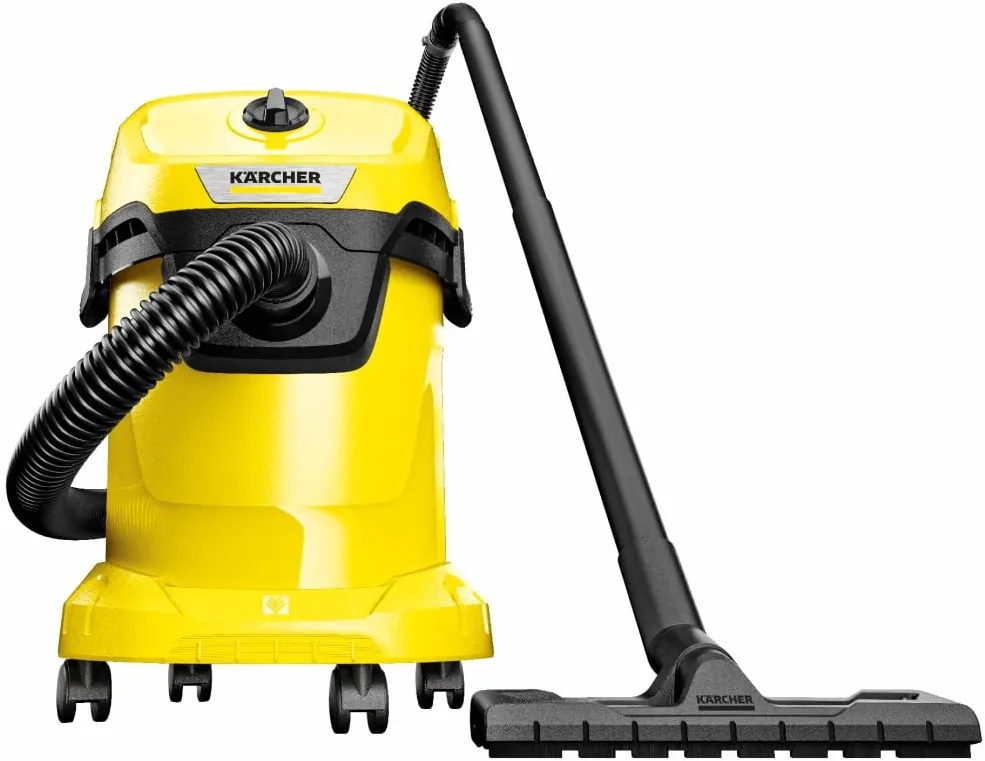
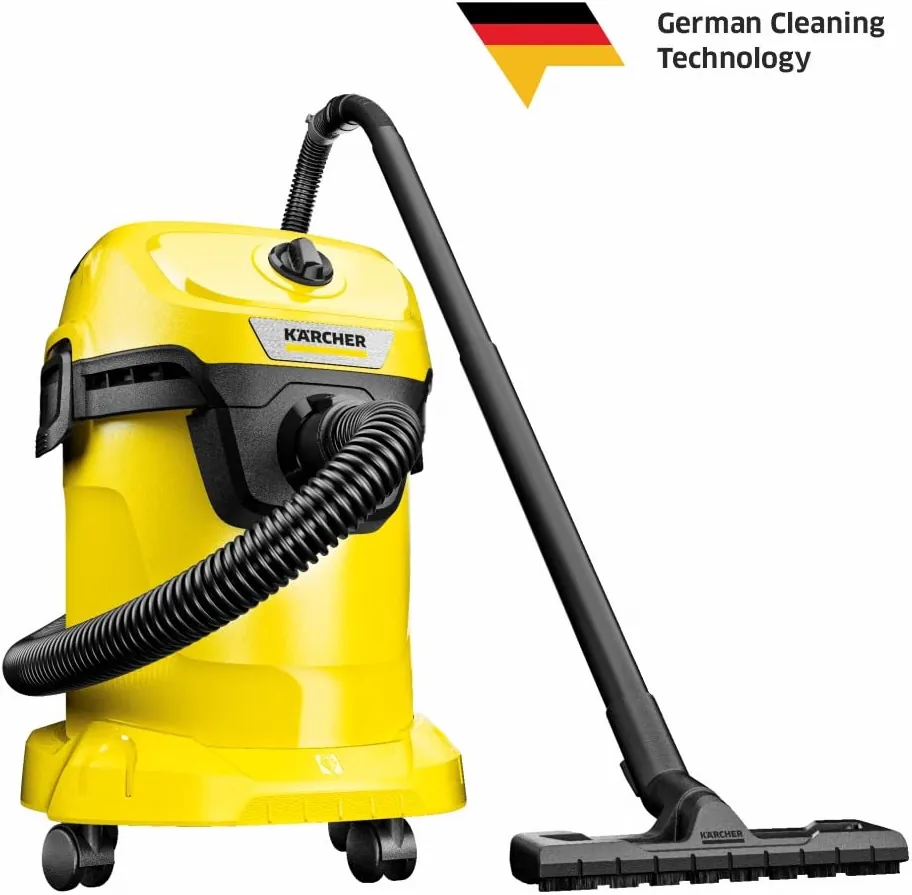
The WD 3 V-17/4/20 belongs to Kärcher’s WD range, the wet and dry vacuums designed for households, from the WD 2 to the WD 6. It sits at the heart of the range: it is the first level with a cartridge filter, whereas the WD 2 makes do with a foam filter that requires a bag for dust. According to Kärcher, it consists of:
- a 1000 W motor head, with an on/off switch, a folding carry handle, a cable hook and hose storage;
- a 17 L plastic tank, described as polypropylene on Amazon, with a bumper and four swivel castors;
- a Pull & Push lock, which opens and closes the head on the tank in one movement;
- a blower outlet, to which you connect the hose;
- a one-piece cartridge filter and a fleece filter bag;
- a 2 m hose 35 mm in diameter, with a removable curved handle, two 0.5 m tubes, a clip-on wet and dry floor nozzle and a crevice nozzle.
The appliance is meant to be a jack of all trades. Among its areas of use, Kärcher lists patios, vehicles, the garage, the workshop, the cellar, picking up liquids, the entrance and the hobby room.
Which version exactly?
Kärcher’s naming system is easy to read once you have the key, and it prevents ordering the wrong appliance.
| Element | Meaning | For the WD 3 V-17/4/20 |
|---|---|---|
| WD 3 | Level in the range (WD 2 to WD 6) | First level with a cartridge filter |
| Letter after WD 3 | V: plastic tank; S: stainless steel tank; P: tool socket | V, plastic tank, no socket |
| First number | Tank capacity in litres | 17 L |
| Second number | Cable length in metres | 4 m |
| Third number | Hose length in decimetres | 20, i.e. 2 m |
The WD 3 S V-17/4/20, tested by Auto Zeitung, shares the WD 3 V’s motor, filter and accessories, with a stainless steel tank. The WD 3 P adds a tool socket with automatic start. Check the exact reference in the title of the listing before ordering, and make sure the plug matches your country.
Power and suction
For the WD 3 V-17/4/20, Kärcher quotes a power input of 1000 W, a suction power of 230 W, a maximum vacuum of 230 mbar and a maximum airflow of 45 l/s. These figures place the appliance in the upper middle of entry-level wet and dry vacuums, with a motor that uses less electricity than older generations at 1400 or 1600 W.
Auto Zeitung’s comparison, published in May 2025, confirms these values in practice: the magazine rates the suction power as high and names the WD 3 S V-17/4/20 the best value in its test, with performance close to the best. Its only notable criticism concerns the lack of power control.
Buyer reviews point the same way. Power comes up as the main positive, on sawdust, soil, patio gravel and crumbs in the car. Disappointments almost always concern fine dust vacuumed without a bag, which clogs the filter: power then drops sharply, which buyers sometimes take for a motor fault.
The lack of control only becomes a nuisance in two cases: when vacuuming light fabrics (thin car mats, curtains) that stick to the nozzle, and when you would like to reduce the noise for a small clean. In both cases, slightly tilting the nozzle is usually enough.
The cartridge filter in use
The cartridge filter is the WD 3 V’s main selling point. It stays in place for both dry and wet vacuuming, which avoids dismantling the appliance between two tasks, as you would with a foam filter.
Kärcher sets three rules of use:
- For fine dust (plaster, sanding, cement), add a filter bag. On WD 3 to WD 6 models, Kärcher states that it is necessary in this case.
- For liquids, vacuum without a bag.
- To clean the filter, rinse it under running water, without rubbing or brushing, then let it dry completely.
The WD 3 V has no filter-cleaning button. When the filter is dirty, you have to open the tank and clean it. For occasional DIY, that makes no difference. For a sanding job lasting several hours, it is the appliance’s main limitation, and the reason the WD 5 and WD 6 models exist. Our filter guide details each situation.
On water and liquids
This is one of the uses where the WD 3 V is most helpful: a leaking washing machine, an overflowing water heater, a cellar flooded after a storm, standing water on a patio or in a garage.
The method is simple. You remove the bag, fit the floor nozzle, whose rubber strips squeegee the water, and move forward slowly. The internal float rises with the water level. When the tank is full, it closes off the suction. Kärcher points out that the motor does not stop: it runs faster, and you must switch it off, then empty the tank.
With 17 litres, the tank needs several emptyings for serious flooding. For a 30 to 40 litre puddle, allow two to three trips. Here, the compact format is an advantage: a full tank is easier to carry and empty than a 30-litre one. Our guide to vacuuming water gives the full method.
On fine dust
This is where you need to be careful. A cartridge filter catches fine dust well, but it gets dirty quickly: plaster or sanding dust forms a compact layer on its surface, which reduces the passage of air and therefore suction.
With the filter bag in place, the appliance keeps its power far longer and emptying happens without a cloud of dust. Only one bag is supplied: buy spare bags (Kärcher reference 2.863-314.0 according to the range data sheet) if you plan to do any work.
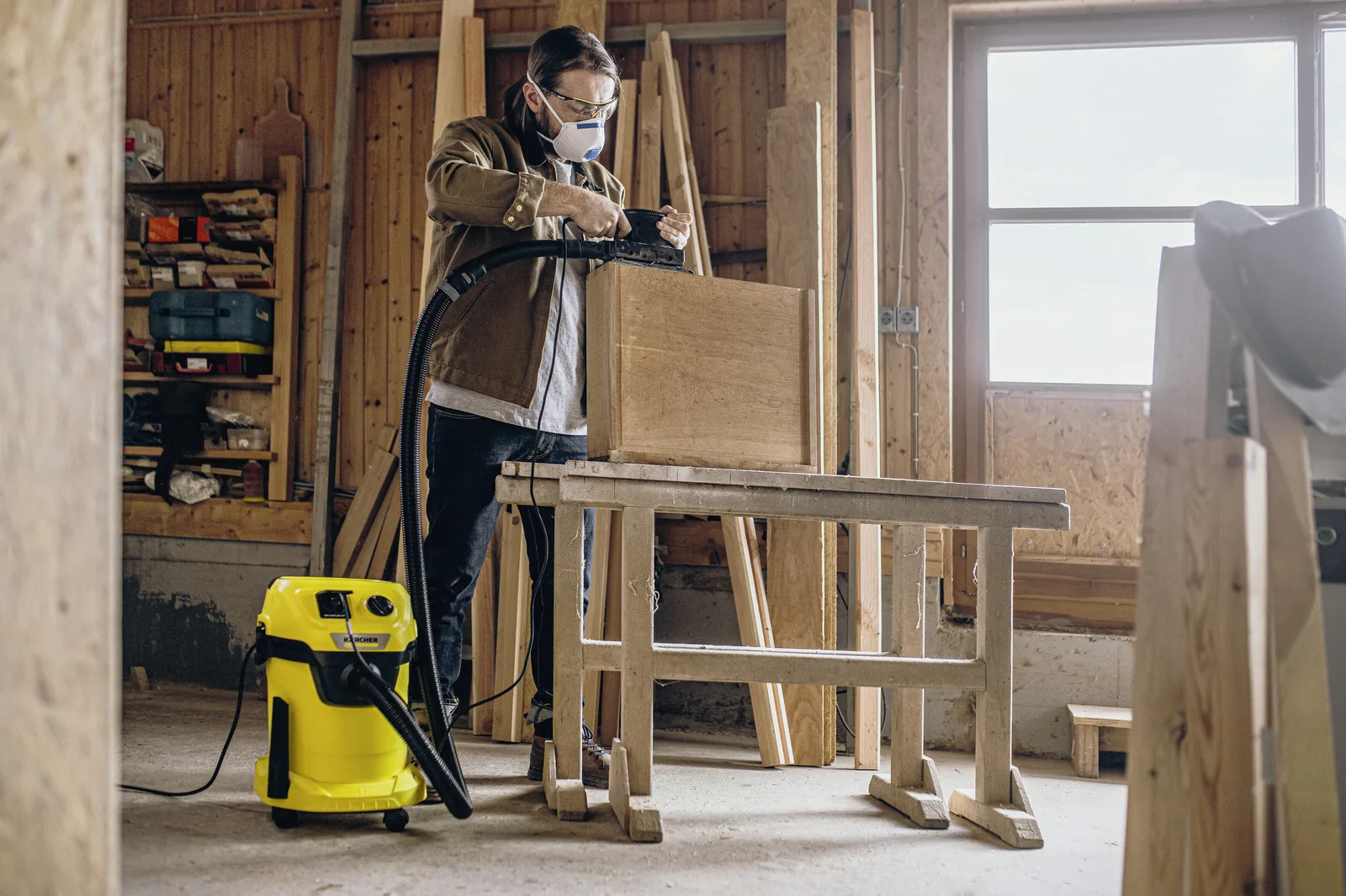
For sanding, the lack of a tool socket means vacuuming afterwards rather than directly. If you sand often, the WD 3 P version or a higher model will suit you better.
The blower function
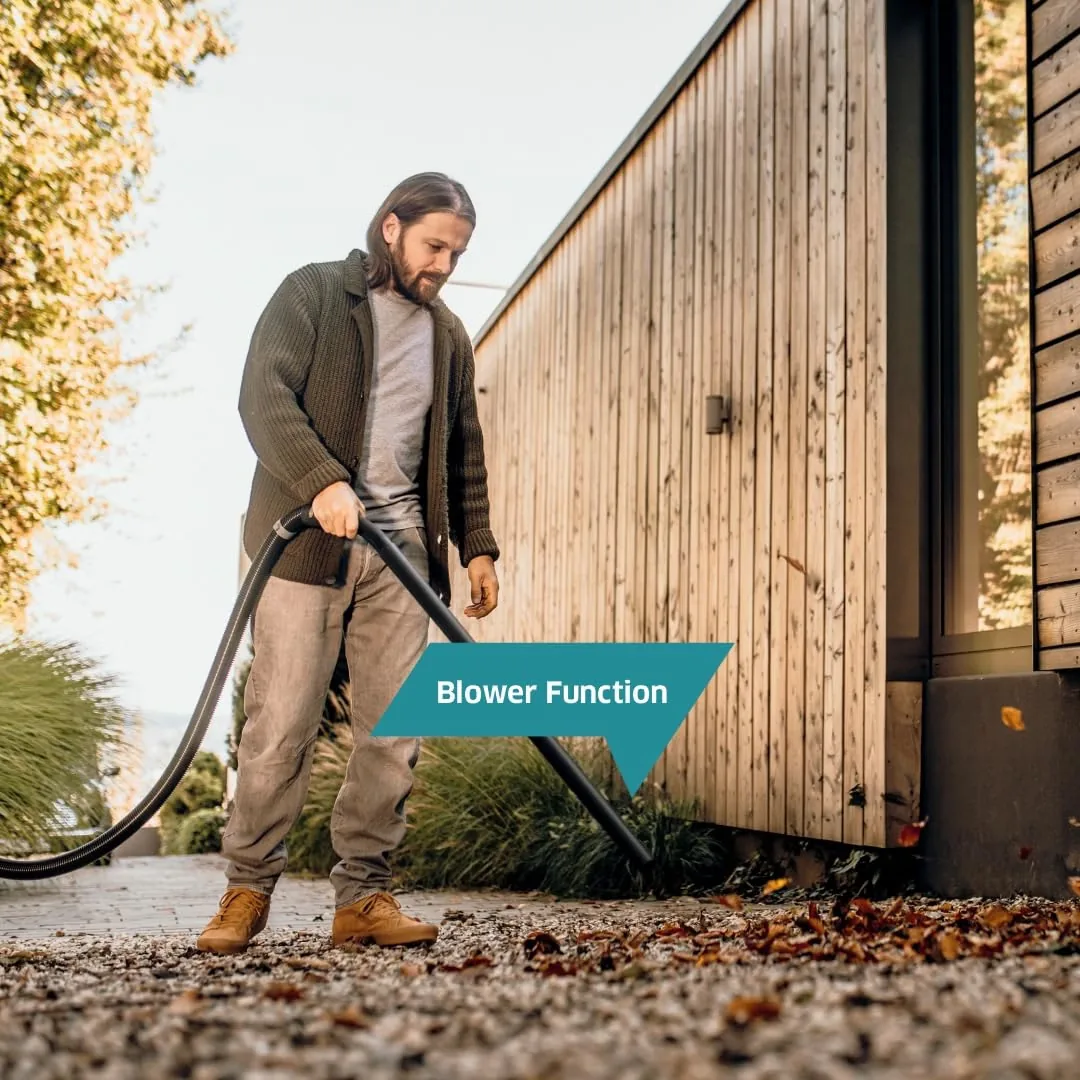
The WD 3 V has an air outlet to which you connect the hose to blow. It is handy for chasing leaves out of corners, cleaning a grille, clearing dust off a workshop shelf or blowing out shavings stuck in a machine.
It does not replace a garden blower: the airflow suits small areas and hard-to-reach places, not clearing the leaves from an entire lawn. With the optional adapter kit (reference 2.863-373.0 according to Kärcher), the blower can also inflate and deflate air mattresses and paddling pools.
Ergonomics and storage
Kärcher has paid attention to the details that matter when an appliance is used often:
- hose storage on the head and a cable hook, which prevent tangles at the back of the garage;
- accessory holders and a storage surface on the head, to put down screws and small parts during a job;
- a parking position to rest the tube during a break;
- a folding carry handle and the Pull & Push lock;
- four swivel castors, without brakes, and a bumper that protects the tank.
The downside comes from two lengths. The 4 m cable and 2 m hose give a reach of about 7 m around the socket, tubes included. That is enough for a room or a car parked in front of the house, but some buyers find them short. A 3.5 m hose extension is available as an accessory, and an extension lead suitable for outdoor use does the rest.
Supplied and optional accessories
| Accessory | Supplied | Use |
|---|---|---|
| 2 m hose, Ø 35 mm, removable handle | Yes | All uses |
| 2 × 0.5 m tubes | Yes | Floors, patio, water |
| Clip-on wet and dry floor nozzle | Yes | Surfaces, liquids |
| Crevice nozzle | Yes | Corners, car, radiators |
| Cartridge filter | Yes | Wet and dry |
| Fleece filter bag | Yes, just one | Fine dust |
| Car kit, interior kit, extensions, tool kit | No, optional | Car, stairs, workshop |
The supplied accessories are made of lightweight plastic, which a few buyers regret. They do the job for household use. Our accessories guide points out which ones are worth having.
Noise, weight and size
Kärcher quotes a sound level of 74 dB(A), usual for a wet and dry vacuum and higher than a recent household vacuum. For an hour of work, ear protection is no luxury.
The appliance weighs 4.5 kg without accessories according to Kärcher, and measures 349 × 328 × 492 mm. Packed, it weighs 6.6 kg according to Kärcher France (6.7 kg on the range data sheet). It fits in a corner of the garage or a cupboard, and can be carried one-handed up a staircase.
Kärcher WD 3 V-17/4/201000 W, 17 L tank, cartridge filter for water and dust, blower function.View on Amazon →What it does well, and less well
| Situation | Expected result | Comment |
|---|---|---|
| Water leak, puddle, cellar | Very good | No bag, empty as soon as the float cuts out |
| Car | Good | Crevice nozzle for corners, an extension helps for the boot |
| Patio, leaves, gravel | Good | Blower handy for corners |
| Sawdust, shavings, drilling | Good | Bag recommended to keep the power |
| Prolonged plaster sanding | Average | Bag mandatory, no filter cleaning or tool socket |
| Everyday floors at home | Average | Noisy and less manoeuvrable than a household vacuum |
| Ash | Do not use | Kärcher advises against it |
A typical Saturday with the WD 3 V
To gauge its versatility, picture an ordinary DIY day.
- In the morning, the car. Cartridge alone, crevice nozzle on the hose with no tube: seats, door sills, boot. The removable handle lets you fit the nozzle directly on the hose.
- Next, the patio. Floor nozzle and two tubes for leaves and soil, then the blower for the corners under the garden furniture.
- In the afternoon, the workshop. You fit the bag before drilling and sanding a shelf. You vacuum the dust as you go.
- At the end of the day, the unexpected. The washing machine leaks. You remove the bag, vacuum the water and empty the tank twice.
- In the evening, the upkeep. You rinse the tank, rinse the filter in clean water and leave it to dry until the next day.
This is exactly the ground it is designed for: a series of small, different tasks, with no complicated dismantling in between.
Buying: version, rights, guarantee
Before ordering, check the exact reference (V-17/4/20), the plug, the accessories included and the seller. The guarantee is two years according to retailer listings, and Kärcher has a network of approved dealers and a repair service. In the UK, the Consumer Contracts Regulations give you 14 days to cancel an online purchase, and the Consumer Rights Act protects you if the goods are faulty or not as described.
Check the price on AmazonKärcher WD 3 V-17/4/20 · new tabThe alternatives
- The WD 3 S V-17/4/20: the same base with a stainless steel tank, more resistant to knocks and easier to clean, usually at a higher price.
- The WD 3 P: adds a tool socket with automatic start, useful if you sand or saw often.
- The WD 5 and WD 6: flat filter with filter cleaning and a bigger tank, for regular DIYers and renovation work.
- The WD 2: simpler, with a foam filter and a mandatory bag for dust. It suits small emergencies.
To compare the families of appliances, see our guide how to choose a wet and dry vacuum.
Our conclusion
The Kärcher WD 3 V-17/4/20 does not try to compete with high-end workshop vacuums. It does very well what most households expect: picking up a water leak, cleaning the car, collecting debris from a small job, blowing leaves off a patio. Its cartridge filter, compact format and storage make it an appliance you get out without hesitation. Those who sand plaster all day or want to plug in their tools will look higher up the range. For everyone else, it is a safe bet, and our detailed verdict helps you decide according to your profile.
Frequently asked questions
Is the WD 3 V-17/4/20 powerful?
Yes for its category: 1000 W power input, 230 W suction power, 230 mbar and 45 l/s according to Kärcher. Auto Zeitung rates its suction power as high on the stainless steel tank version.
Do you need to change the filter between dry and wet?
No. The cartridge filter stays in place. Simply add a bag for fine dust and remove it for water.
How many bags are supplied?
Just one. Spare bags are available from Kärcher and on Amazon.
Can you plug a sander into it?
Not directly: it has no tool socket. You need the WD 3 P for that. A tool extraction kit is available as an accessory, but the vacuum does not start automatically with the tool.
Can you vacuum ash?
No. Kärcher states that its wet and dry vacuums are not suitable for vacuuming ash.
Is it noisy?
Kärcher quotes 74 dB(A), a usual level for this category.
What should you do if the power drops?
Check the filter, the bag and the hose. In the vast majority of cases, a filter clogged by fine dust is the cause.
Cleaning without limits.
1000 W · 17 L tank · 2 m hose · 4 m cable · blower · cartridge filter. Prices change often on Amazon: check the price, the seller and the exact version (WD 3 V, WD 3 S, WD 3 P) before you order.
Check the price on AmazonAffiliate link · new tab