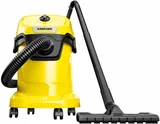
Water, dust, leaves. It picks up everything.
Which wet and dry vacuum should you choose in 2026? Our criteria (power, filter, tank, accessories), our guides by use and our reference model, the Kärcher WD 3 V-17/4/20: 1000 W, a 17 L tank, a cartridge filter for water and dust, and a blower function.
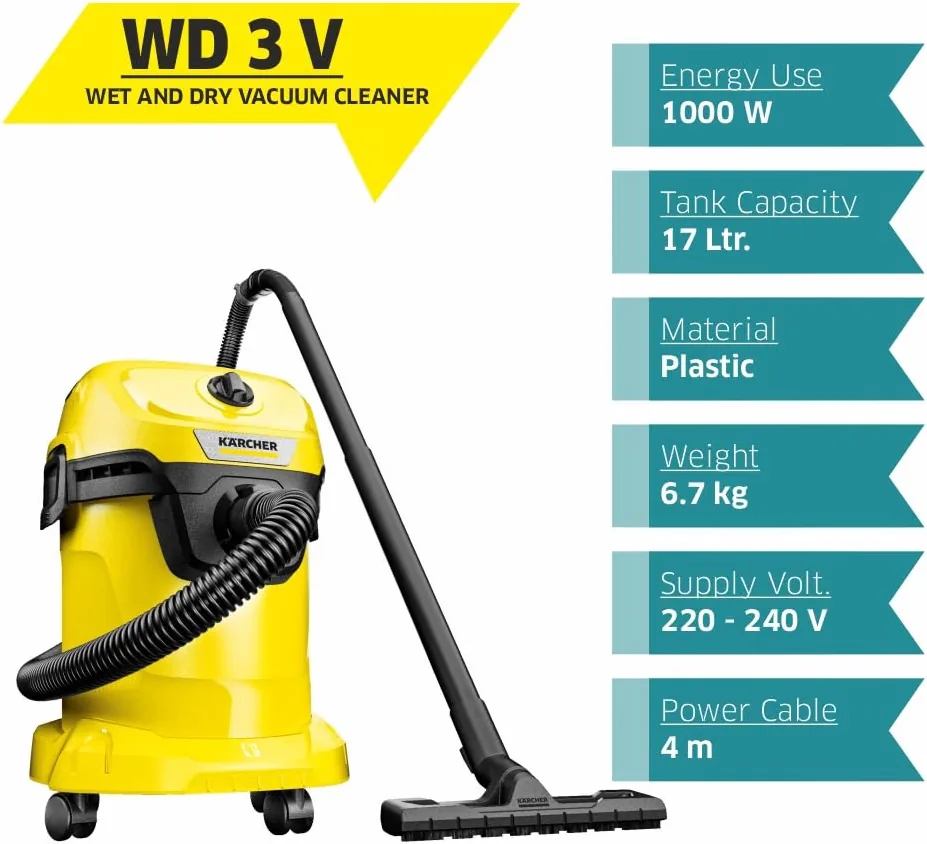
- 1000 WPower
- 17 LTank
- 2 mHose
- 4 mCable
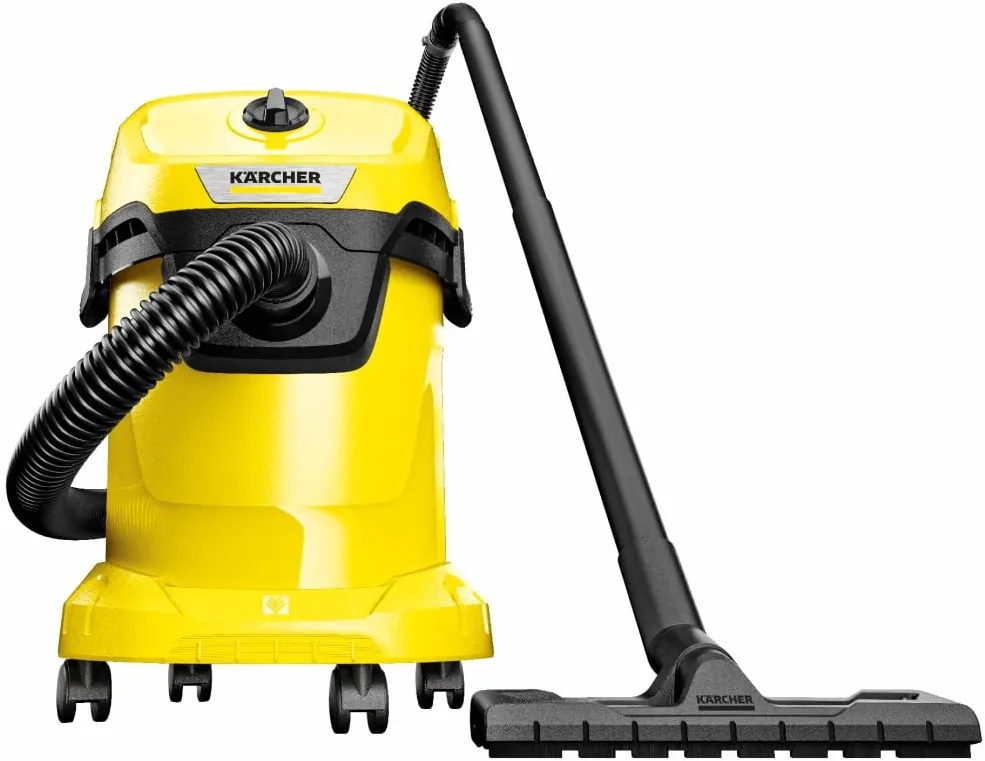
- Wet and dry
- 1000 W
- 17 L tank
- Blower function
- 2 m hose
- Cartridge filter
- Floor and crevice nozzles
- 4 m cable
One appliance, every job.
What the Kärcher WD 3 V-17/4/20 does well. Select a feature to see it in a picture.
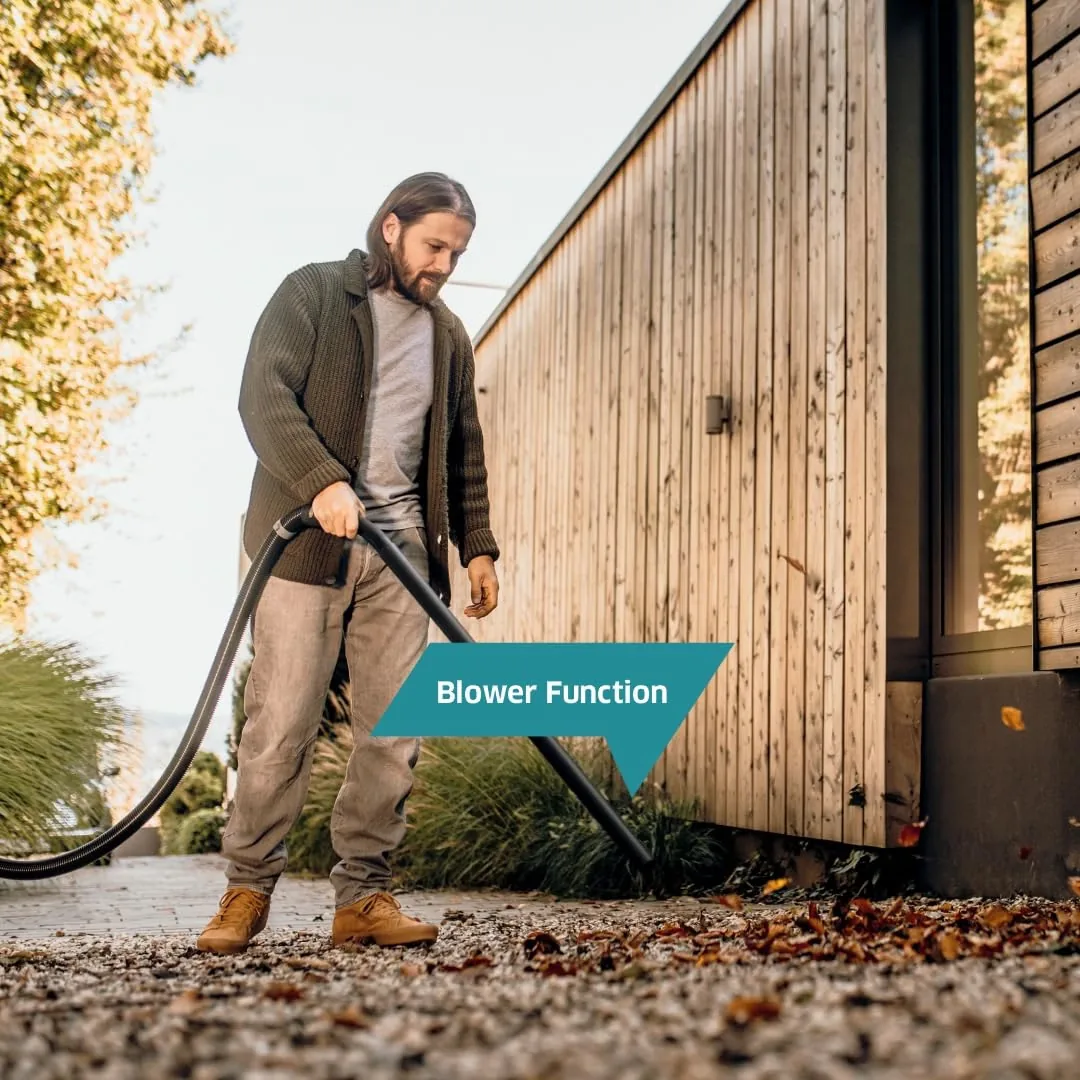
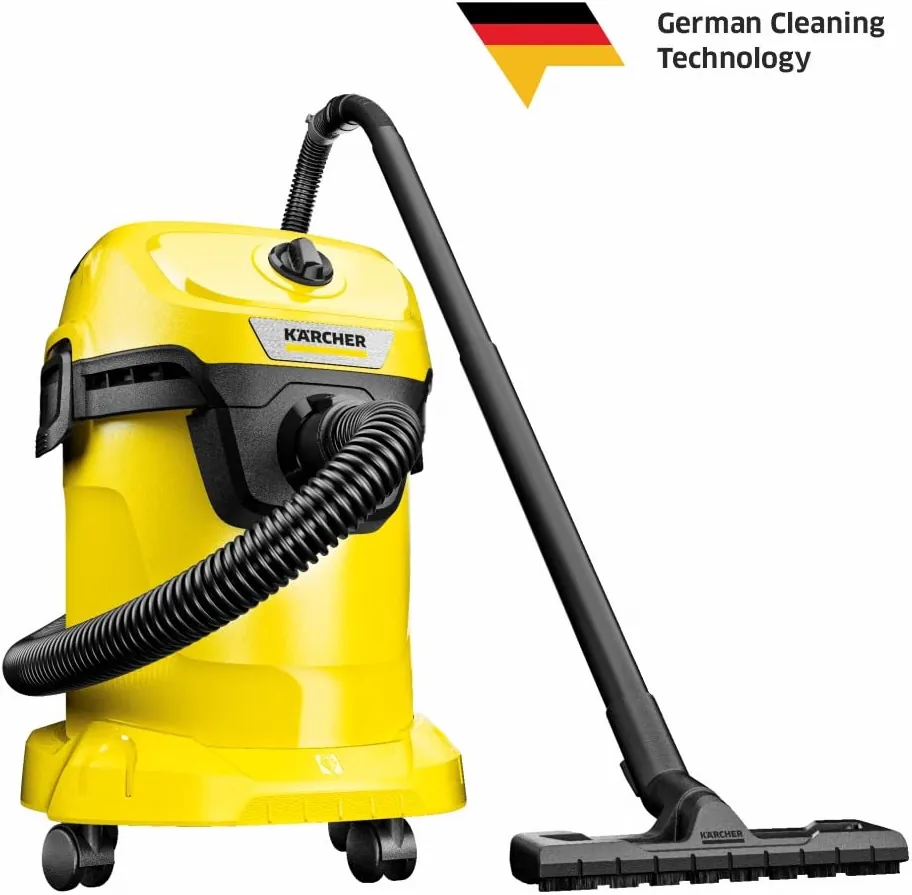
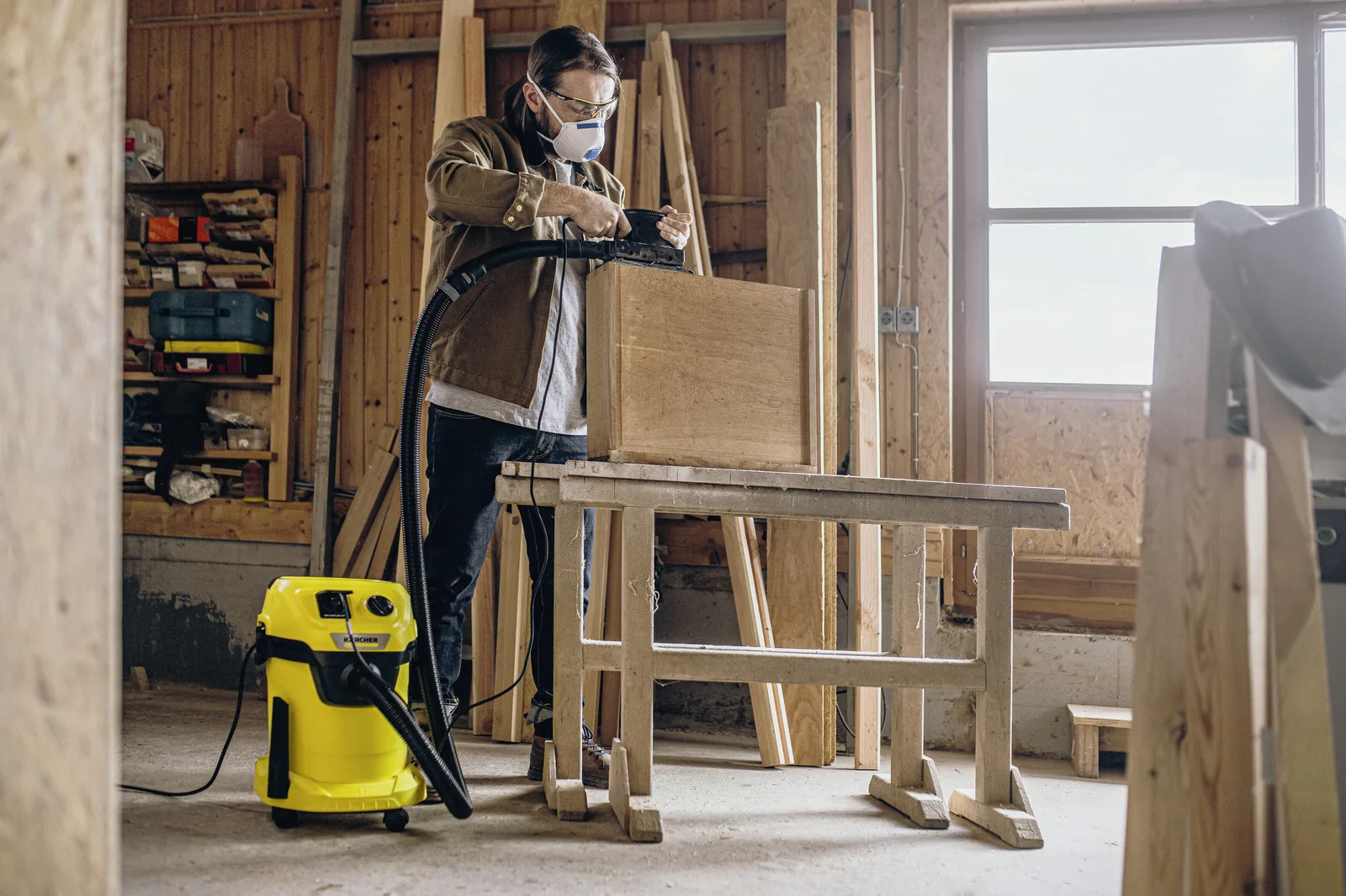
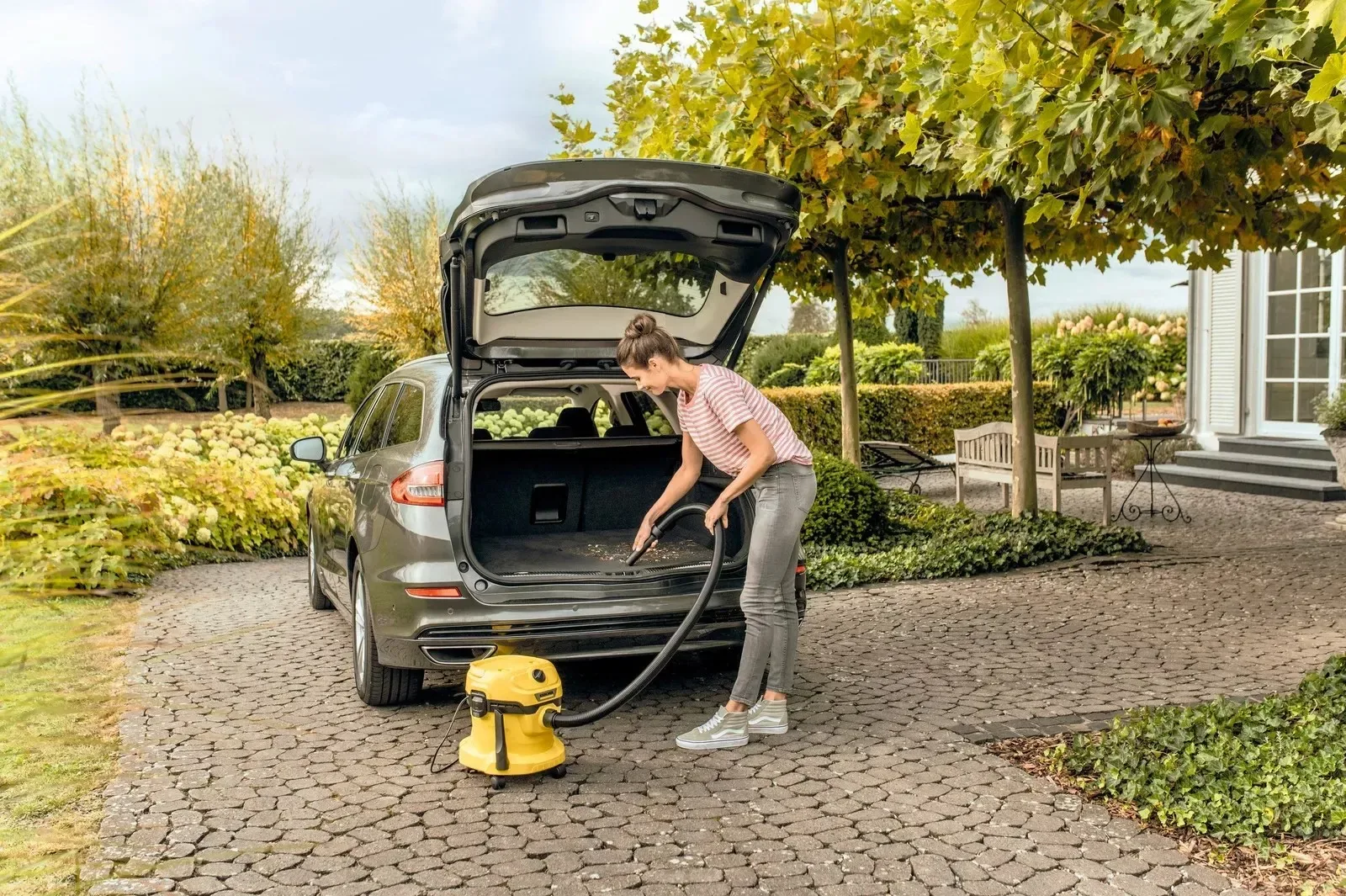
- 1000 WPower input
- 17 LPlastic tank
- 230 mbarMaximum vacuum claimed
- 45 l/sMaximum airflow claimed
- 4 mPower cable
- 2 mSuction hose
Wet or dry, no filter change.
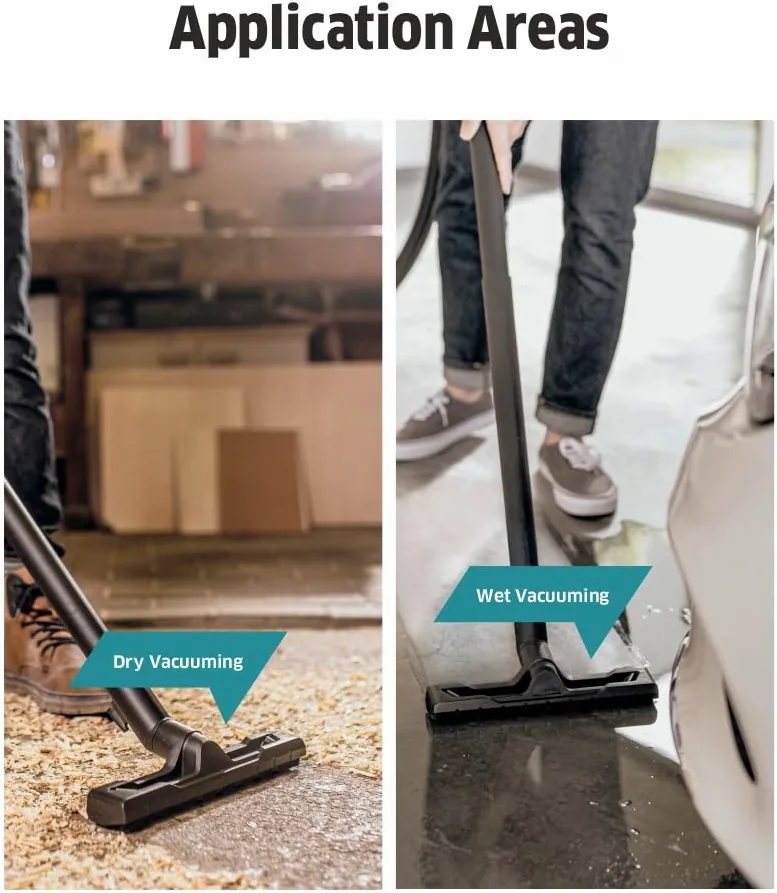
- DryDust, crumbs, sawdust, dry soil
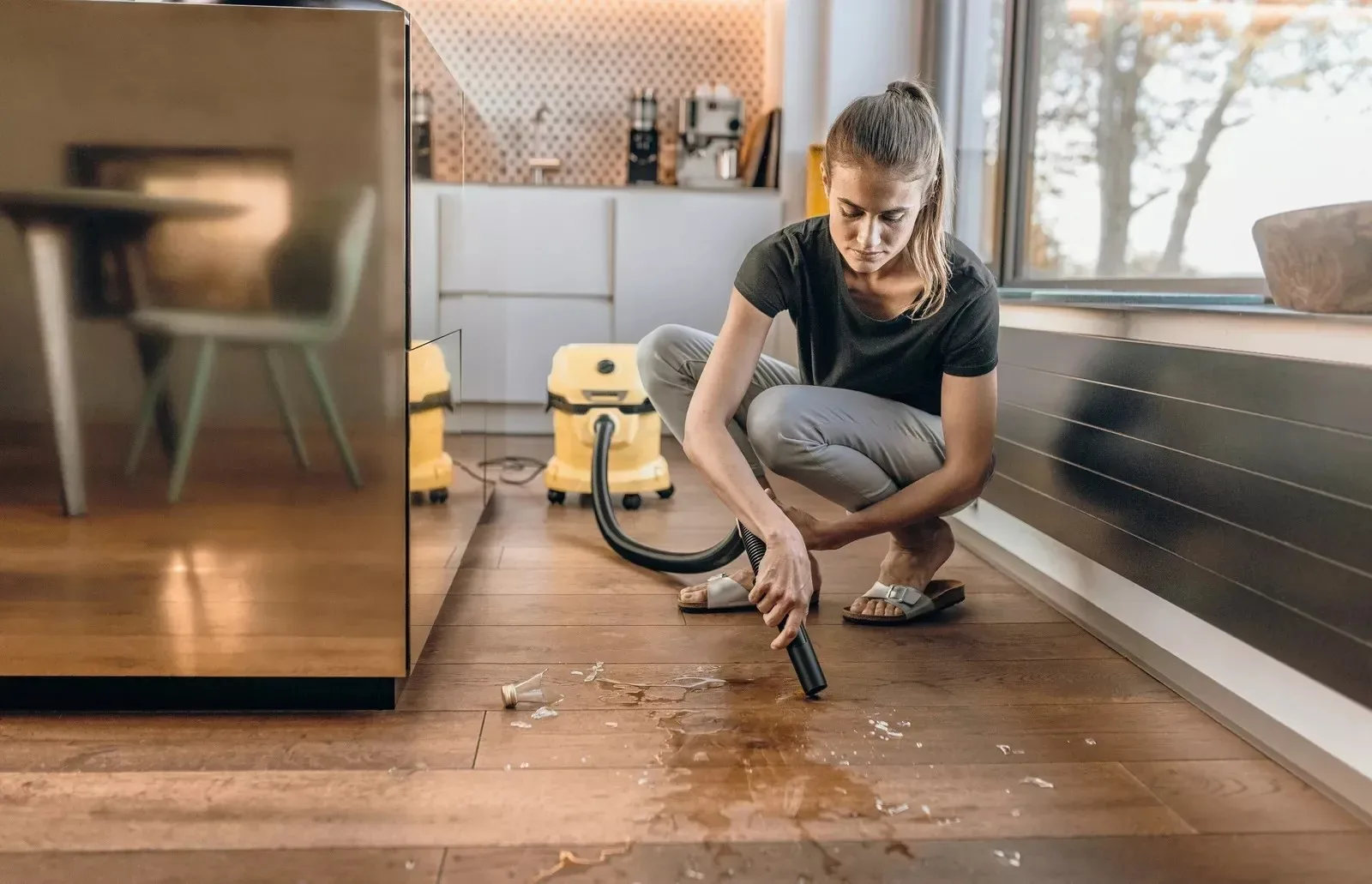
- WetWater, spilled liquids, wet dirt
- + bagRequired for fine dust according to Kärcher
- No bagFor vacuuming water, as Kärcher recommends
- RinsingFilter rinsed under running water, without rubbing
- FloatShuts off suction when the tank is full
Instructions taken from Kärcher’s FAQ on wet and dry vacuums. Ash must not be vacuumed with this appliance, even cold, without a pre-separator. See our filter guide.
Guide contents
The essentials in 30 seconds:
- A wet and dry vacuum picks up dust, debris, sawdust, soil and liquids into a large tank. It is the tool for emergencies and big jobs, where your household vacuum gives up.
- It does not replace everything: it is noisier, bulkier and less comfortable than a household vacuum for everyday cleaning of the floors in your home.
- The criteria that matter: the filter (cartridge, bag, flat filter, filter cleaning), real power (vacuum in mbar and airflow in l/s), the tank, the length of the hose and cable, the accessories and the tool socket.
- The watts printed in big type measure electricity consumption, not suction efficiency: look at vacuum and airflow instead.
- Our reference model, the Kärcher WD 3 V-17/4/20, combines 1000 W, a 17 L tank, a cartridge filter that handles wet and dry dirt without a change, and a blower function, in a 4.5 kg format according to Kärcher.
Comparison: the right wet and dry vacuum for you
There is no best wet and dry vacuum in absolute terms. There is the best appliance for your jobs: a homeowner who wants to vacuum the car, the leaves on the patio and a leak under the sink does not have the same needs as a DIYer who sands plasterboard every weekend. This comparison ranks the main families of appliances against the criteria that really change how you use them, then gives the right choice for each profile.
| Criterion | Kärcher WD 3 V-17/4/20 | Small entry-level model | Mid-range model with flat filter | Workshop model with filter cleaning |
|---|---|---|---|---|
| Tank | 17 L plastic | 10 to 15 L | 20 to 25 L, often stainless steel | 25 to 30 L |
| Filter | Cartridge, wet and dry without a change | Foam or cartridge filter, bag often mandatory | Pleated flat filter, quick removal | Flat filter with filter cleaning |
| Tool socket | No (WD 3 P version) | No | Depending on version | Yes, often with automatic start |
| Blower | Yes | Sometimes | Yes | Yes |
| Typical weak point | No power control or filter cleaning | Tank fills quickly, fragile filter | Price, bulk | Price, weight, noise |
| Ideal for | Home, car, garden, occasional DIY, water leaks | Small emergencies, flats | Regular DIYers, garages | Workshops, renovation, frequent fine dust |
This table shows trends: values vary from one model to another, and only the spec sheets allow an exact comparison between two appliances. To refine your choice, our calculator tells you whether the WD 3 V suits your jobs and how to set it up.
What is a wet and dry vacuum?
A wet and dry vacuum, also called a multi-purpose vacuum, a workshop vacuum or a wet/dry vac, is a vacuum designed to pick up what a household vacuum cannot handle: coarse dust, light rubble, sawdust, shavings, soil, leaves and liquids. It is made up of a motor head sitting on a large tank, a filter that protects the motor, a wide-diameter hose and nozzles suited to both wet and dry work.
Its strength comes down to two words: volume and toughness. A tank of several dozen litres takes in quantities that a household vacuum bag could never hold. The wide hose swallows debris that would block an ordinary tube. And the appliance picks up water, which a household vacuum must never do.
It has its limits. It is noisier, its filter clogs quickly on very fine dust unless protected by a bag, it is not designed for ash, and it remains less comfortable on the floors of your home than a stick or cylinder vacuum. It is a tool for emergencies and jobs, not an everyday vacuum.
The vocabulary adds to the confusion. In shops you will find “wet and dry vacuum”, “multi-purpose vacuum”, “workshop vacuum”, “site vacuum”, “wet/dry vac” or “drum vacuum”. What matters is not the name, but the filter, the real power, the tank and the accessories.
How a wet and dry vacuum works
The principle is simple, and it explains most of the instructions for use.
- The motor, housed in the head, drives a fan that creates a vacuum in the tank. Air from the room rushes in through the hose to fill this void and carries the debris with it.
- The tank acts as a settling chamber: as it enters this large volume, the air slows down and heavy debris falls to the bottom. Liquids collect there in the same way.
- The filter, placed between the tank and the motor, catches dust before the air leaves. It protects the motor and determines the quality of the air that comes back out.
- The float rises with the water level. When the tank is full, it closes the suction opening. Kärcher points out that the appliance does not switch off: it runs at a higher speed, and you must turn it off and empty the tank.
- The air outlet can be used as a blower on models that allow it: you connect the hose to it to blow leaves or dust out of corners.
The filter bag, when used, sits at the tank inlet: it captures fine dust before it reaches the main filter, which keeps the power up for longer and makes emptying easier. For water, you remove it.
Wet and dry vacuum or household vacuum
The two appliances do not do the same job. The table below sums up the differences that matter day to day.
| Criterion | Wet and dry vacuum | Household vacuum |
|---|---|---|
| Liquids | Yes, with the right filter and no bag | Never |
| Coarse debris, light rubble, sawdust | Yes, thanks to the wide hose and the tank | Risk of blockage and damage |
| Fine dust (plaster, sanding) | Yes, with a filter bag | Avoid: bag and motor get overloaded |
| Everyday floor cleaning at home | Possible, less comfortable | Its home ground |
| Noise | Higher | Lower |
| Bulk | A 15 to 30 L tank to store | Compact |
For most households, the right answer is to have both: a household vacuum for routine cleaning, and a wet and dry vacuum stored in the garage for everything else. Our guide to all the uses details what one does that the other cannot.
Our pick: the Kärcher WD 3 V-17/4/20
Among entry-level wet and dry vacuums, we recommend the Kärcher WD 3 V-17/4/20 to households that want a single appliance for the garage, the workshop, the car, the garden and water leaks. It does not win on every count: its power cannot be adjusted, and it has neither filter cleaning nor a tool socket. It does, however, bring together the essentials for varied household use.
- 1000 W power input, 230 W suction power, up to 230 mbar vacuum and up to 45 l/s airflow according to Kärcher.
- A one-piece cartridge filter that lets you vacuum dust and liquids without changing the filter, with a filter bag supplied for fine dust.
- A 17 L plastic tank, a 2 m hose with a removable handle, two 0.5 m tubes and a 4 m cable.
- A blower function, hose storage on the head, a cable hook, holders for the accessories and a surface to put down small parts.
- A compact format: 4.5 kg without accessories and 349 × 328 × 492 mm according to Kärcher, on four castors.
Published tests confirm its position. The German magazine Auto Zeitung named the WD 3 S V-17/4/20 version, identical but with a stainless steel tank, the best value in its comparison of wet and dry vacuums, rating its suction as good, close to the best, with only one real criticism: the power cannot be adjusted. Buyer feedback points the same way and mainly highlights the filter clogging quickly on fine dust when the bag is forgotten. Our specifications page lists every figure with its source.
The 10 criteria of a good wet and dry vacuum
- The filter. Foam, cartridge or flat filter, with or without filter cleaning: this decides whether the appliance keeps its power on fine dust.
- Vacuum. Expressed in millibars (mbar) or kilopascals, it shows the suction force through a small opening.
- Airflow. In litres per second (l/s), it shows how much air, and therefore debris, the appliance moves.
- The tank. Capacity, material (plastic or stainless steel) and how easy it is to empty.
- The hose. Length, diameter and a removable handle so you can fit nozzles directly.
- The cable. Its length determines your reach without an extension lead.
- The accessories. Wet and dry floor nozzle, crevice nozzle, tubes, and optional accessories for the car or the workshop.
- The tool socket. Useful if you want to extract directly behind a sander or a saw.
- The blower. Handy for leaves, corners and inflating, with the right adapter.
- Noise and bulk. Sound level, weight, accessory storage on the appliance.
Our guide how to choose a wet and dry vacuum details each criterion, with figures to aim for and a pre-purchase checklist.
Watts, millibars, litres per second: reading the figures
Wet and dry vacuum spec sheets line up units that do not measure the same thing. Mixing them up leads to misleading comparisons.
| Figure | What it measures | What it does not tell you |
|---|---|---|
| Power input (W) | The motor’s electricity consumption | Suction efficiency: a motor can consume a lot and suck only moderately |
| Suction power (W) | The power transferred to the air, often called “air watts” | Behaviour depending on the nozzle and the state of the filter |
| Vacuum (mbar or kPa) | Maximum suction force, opening almost closed | The volume of air moved |
| Airflow (l/s) | The volume of air moved, opening wide open | Suction force through a small nozzle |
| Tank (L) | The total volume of the container | The usable volume for water, limited by the float |
| Sound level (dB(A)) | Noise measured to the manufacturer’s standard | Real nuisance depending on the room and the distance |
For the WD 3 V-17/4/20, Kärcher quotes 1000 W power input, 230 W suction power, 230 mbar and 45 l/s maximum, and 74 dB(A). These values are useful for comparing models from the same brand. From one brand to another, measurement methods may differ: independent tests remain the best reference. Our article power: watts, millibars and airflow explains these units in detail.
Above all, be wary of the watts printed in big type on the box. A 1400 W vacuum does not necessarily suck better than a 1000 W model: the fan design, the airtightness, the hose diameter and the state of the filter count as much as the motor’s consumption.
The filter: the central question
On a wet and dry vacuum, the filter makes the difference between an appliance that keeps its power and one that runs out of breath after five minutes of sanding. Three main families coexist.
- The foam filter, on small models, is fine for water but requires a bag for dust. At Kärcher, foam filter models (WD 2) must always be used with a bag.
- The cartridge filter, as on the WD 3, handles wet and dry dirt without a change. For fine dust, Kärcher says to add a filter bag; for water, to vacuum without a bag.
- The pleated flat filter, on higher-end models, comes out quickly and can be combined with a filter-cleaning system that shakes the filter to restore its power.
Two points are often forgotten. The filter is cleaned under running water, without rubbing or brushing, and must dry completely before being used on dust again. And a clogged filter greatly reduces suction: when the motor sound changes and the appliance stops sucking, it is almost always the filter or the bag. Our filter guide goes through each case.
Vacuuming water: what you need to know
This is the reason behind many purchases: a leaking washing machine, a cellar flooded after a storm, an aquarium to empty, a waterlogged patio. A few rules avoid unpleasant surprises.
- Remove the filter bag: Kärcher recommends vacuuming liquids without a bag, which also spares the filters.
- Watch the level: when the float shuts off suction, the motor revs up. Switch off immediately and empty the tank.
- Plan for emptying: with a 17 L tank, a 40 L puddle means at least three emptyings. The usable volume is a little below the nominal volume.
- Empty and dry after use: tank, nozzles and filter, to avoid smells.
- Cut the power in the flooded area before stepping in if the water may have reached an electrical installation, and never stand the appliance in water.
Our guide vacuuming water details the method, from water damage to emptying a paddling pool.
Home, workshop, garden, car: the uses
A wet and dry vacuum adapts its accessories and set-up to the job, as long as you choose the right one.
| Use | Accessory | Filter set-up | Watch out for |
|---|---|---|---|
| Water, leaks, puddles | Floor nozzle with rubber strips | Cartridge, no bag | Empty as soon as the float cuts out |
| Sawdust, shavings | Floor nozzle or tube alone | Cartridge, bag recommended | Empty before the tank overflows with shavings |
| Plaster, sanding, cement | Tube alone or tool kit | Cartridge + bag mandatory | Change the bag before it is saturated |
| Car | Crevice nozzle, optional nozzles | Cartridge | Remove mats and objects first |
| Patio, garden | Floor nozzle, blower | Cartridge | Do not vacuum stones too big for the hose |
Our guide to all the uses details the settings for each one, and our article on vacuuming your car gives the full method for the cabin and the boot.
Accessories: what makes the difference
According to Kärcher, the WD 3 V-17/4/20 comes with a 2 m hose, two 0.5 m tubes, a clip-on wet and dry floor nozzle, a crevice nozzle, a cartridge filter and a filter bag. That covers most uses. Kärcher offers compatible optional accessories, including:
- spare filter bags and a replacement cartridge filter;
- an interior cleaning kit for the car;
- a 3.5 m hose extension and a tube extension;
- an extra-long crevice nozzle and a nozzle for vehicles;
- a blower adapter kit, used to inflate and deflate air mattresses and paddling pools;
- a power tool extraction kit and a drilling dust collector.
Our guide to accessories and consumables explains which ones are worth it for your use.
Using it well day to day
- Choose the set-up: cartridge alone for water and debris, cartridge and bag for fine dust.
- Fit the right nozzle: floor nozzle for surfaces, crevice nozzle for corners and the car, tube alone for coarse debris.
- Unwind the cable fully and plug it into an earthed socket, away from water.
- Vacuum while moving slowly: the airflow does the work, not the speed of your movement.
- Listen to the sound: a change in pitch signals a clogged filter, a full bag or a full tank.
- Empty after every use, especially after water or wet debris.
- Store the hose and accessories on the appliance, with the cable wound on its hook.
Our how-to guide covers each step with the Kärcher WD 3 V-17/4/20.
Maintenance: the habits that matter
A wet and dry vacuum needs little maintenance, but a few regular habits prevent smells, loss of power and premature wear.
- Empty the tank after every use, and rinse it after dirty water.
- Clean the filter under running water, without rubbing or brushing, then let it dry completely.
- Change the bag as soon as it is full, without waiting for it to tear.
- Rinse the nozzles after vacuuming liquids, and check the rubber strips.
- Check the hose: a piece of debris stuck inside greatly reduces suction.
- Store it dry, with the lid open if the tank is still damp.
Our guide to wet and dry vacuum maintenance gives the full schedule.
Mistakes to avoid
- Vacuuming fine dust without a bag: the cartridge filter clogs in a few minutes.
- Vacuuming water with the bag in: it soaks up water and may tear.
- Letting it run after the float cuts in: switch off and empty.
- Refitting a damp filter to vacuum dust: the dust sticks and blocks the filter.
- Vacuuming ash, even cold, without a suitable pre-separator.
- Forgetting to empty after water: smells and deposits guaranteed.
- Believing that watts tell you everything: compare vacuum and airflow.
Safety: what you must never vacuum
- Ash and embers: Kärcher states that its wet and dry vacuums are not suitable for vacuuming ash; cold ash calls for a pre-separator or an ash vacuum.
- Flammable liquids (petrol, solvents, thinners) and their vapours.
- Corrosive or toxic products: acids, concentrated chemicals.
- Hazardous dust such as asbestos: it calls for certified professional vacuums and specific procedures, not a household appliance.
- Water near a live electrical installation: cut the power to the area before stepping in.
Always unplug the appliance before changing the filter or emptying the tank, and follow your model’s manual.
Who it suits, and who it does not
The WD 3 V suits you if
- You want a back-up vacuum for the garage, the cellar and the garden
- You want to pick up water from a leak or minor flooding
- You clean your car yourself
- You do a bit of DIY from time to time: sawdust, drilling, small jobs
- You want a compact appliance with consumables that are easy to find
It does not suit you if
- You sand plaster or concrete for several hours a week
- You want to plug your sander or saw into the vacuum
- You need to adjust the suction power
- You are looking for a vacuum for everyday floor cleaning at home
- You need to vacuum fireplace ash
Our detailed verdict looks at each of these profiles.
Buying on Amazon: what to check
The WD 3 range comes in many variants and there are plenty of sellers. Before you buy, check:
- The exact version: WD 3 V (plastic tank), WD 3 S (stainless steel tank), WD 3 P (tool socket), V-17 or V-19 (tank capacity), /4/ or /6/ (cable length).
- The plug: the WD 3 V-17/4/20 is a 220 to 240 V model; check that the listing is for the plug used in your country.
- The accessories included: hose, tubes, nozzles, filter and number of bags.
- The seller: Amazon or a third-party seller, and its return conditions.
- The guarantee: two years according to retailer listings, on top of your statutory rights.
- The price, which changes often: compare over a few days before buying.
In the UK, the Consumer Contracts Regulations give you 14 days to cancel an online purchase, and the Consumer Rights Act requires goods to be of satisfactory quality, fit for purpose and as described.
Check the price on AmazonKärcher WD 3 V-17/4/20 · new tabSix myths about wet and dry vacuums
- “It is only for builders.” Most are bought for the garage, the car, the garden and water leaks. Kärcher designs the WD range for households.
- “It can replace my household vacuum.” It can help out, but it is noisier and less manoeuvrable on everyday floors and rugs.
- “More watts means more suction.” Power input measures consumption. Suction power, vacuum and airflow are what matter.
- “It switches off when the tank is full.” The float shuts off suction, but the motor keeps running, faster. You have to switch it off.
- “The filter bag is optional.” For fine dust on WD 3 to WD 6 models, Kärcher considers it necessary.
- “A bigger tank is always better.” A 30 L tank full of water is heavy and hard to empty; a 17 L tank is often handier at home.
Our editorial method
We do not receive appliances from brands and we do not publish fake tests. Our guides are based on manufacturers’ spec sheets and documentation, on tests published by the specialist press, and on an analysis of buyer reviews, summarised without being copied. Figures are always quoted with their source. The site is funded by Amazon affiliate links, flagged as such, which do not change your price. More details on our affiliate disclosure page.
Frequently asked questions
What is the best wet and dry vacuum?
It depends on your jobs. For varied household use (garage, car, garden, water leaks, occasional DIY), we recommend the Kärcher WD 3 V-17/4/20. For a workshop or regular plastering work, a model with a flat filter, filter cleaning and a tool socket will be better suited.
Can you vacuum water with a wet and dry vacuum?
Yes, that is what it is for. Remove the filter bag, watch the level and switch the appliance off as soon as the float shuts off suction, then empty the tank.
Do you need a bag in a wet and dry vacuum?
On Kärcher models with a cartridge or flat filter (WD 3 to WD 6), the bag is necessary for fine dust. For other uses, vacuuming without a bag is fine, and for water, Kärcher recommends vacuuming without a bag.
Can it replace my household vacuum?
It can help out, but it is noisier and less manoeuvrable than a household vacuum. For everyday floor cleaning, a stick or cylinder vacuum remains more comfortable.
Can you vacuum ash?
No. Kärcher states that its wet and dry vacuums are not suitable for ash. Cold ash is vacuumed with a pre-separator or an ash vacuum.
What does V-17/4/20 mean?
In Kärcher’s naming system, the number after the letter is the tank capacity (17 L), the next one the cable length (4 m) and the last one the hose length (2 m, written 20). The letters S and P denote a stainless steel tank and a tool socket.
Does the WD 3 V-17/4/20 have a tool socket?
No. The power tool socket with automatic start is found on the WD 3 P version.
How powerful is the WD 3 V-17/4/20?
Kärcher quotes 1000 W power input, 230 W suction power, a maximum vacuum of 230 mbar and a maximum airflow of 45 l/s.
Is it noisy?
Kärcher quotes 74 dB(A). That is a usual level for a wet and dry vacuum, higher than a household vacuum: consider ear protection for a long job.
How much does it weigh?
4.5 kg without accessories according to Kärcher, and 6.6 to 6.7 kg packed according to the spec sheets.
How do you clean the cartridge filter?
Under running water, without rubbing or brushing, then leave it to dry completely before using it on dust. Replace it if it is torn or misshapen.
Can it be used as a leaf blower?
Yes, for corners and small areas: you connect the hose to the air outlet. For a large garden, a dedicated blower remains more effective.
What guarantee does it come with?
Two years according to retailer listings, on top of your statutory consumer rights against the seller. Kärcher also has a network of repairers and a repair service.
Is the 2 m hose long enough?
For most uses, yes, together with the 4 m cable and the two tubes. For the car or the stairs, a 3.5 m hose extension is available as a Kärcher accessory.
Move your mouse. It sucks it up.
Hover over the picture, or slide your finger across it: the nozzle follows your movement and swallows the debris. A simple visual demonstration to get a feel for it, not a measurement.

Interactive illustration: the counter is a game, not a measurement. Real-world performance is covered in our review.
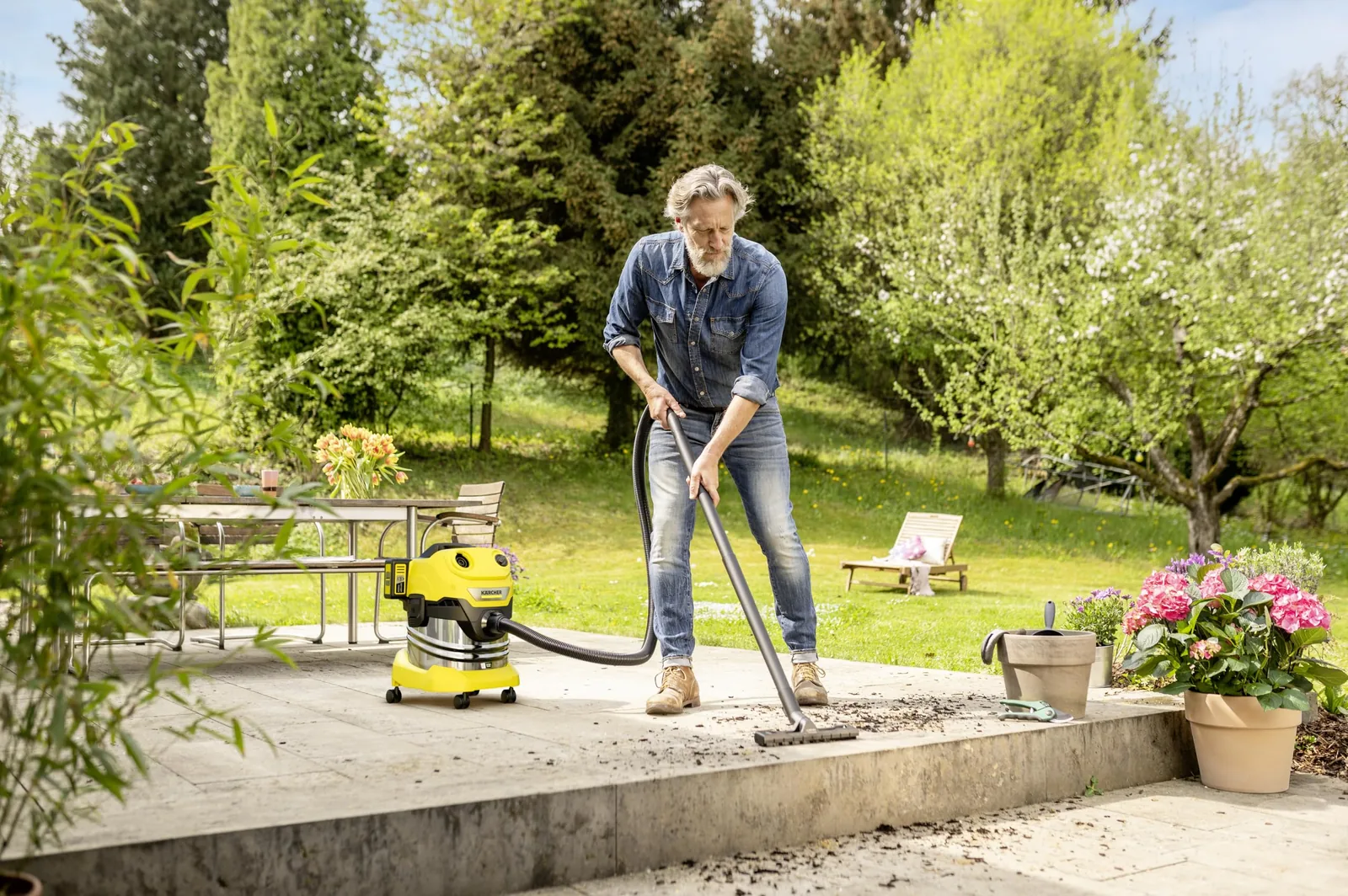
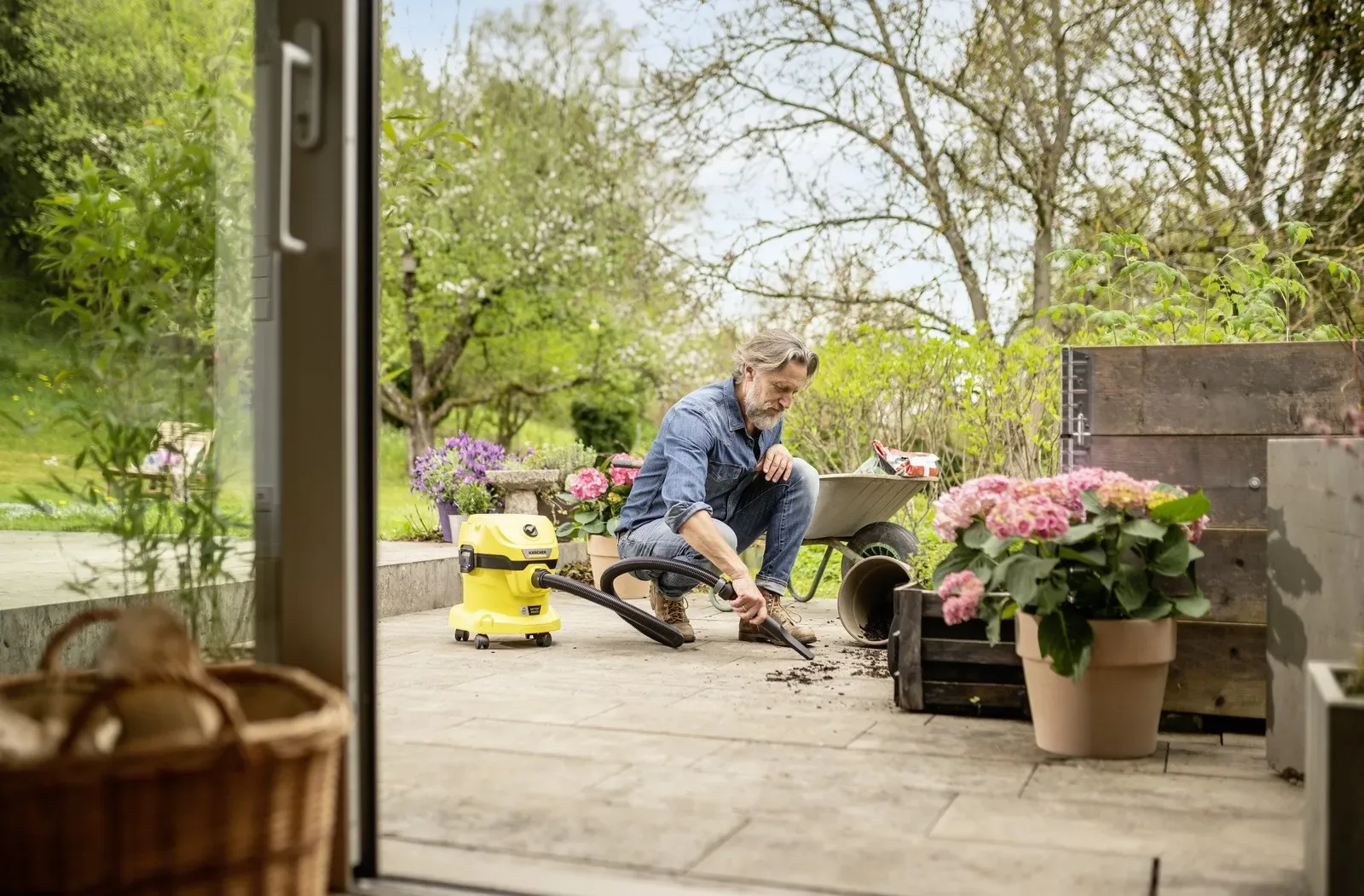
Home, garden, workshop, car.
Where a wet and dry vacuum comes into its own: the places where your household vacuum gives up.
Technical specs.
- Power input1000 W
- Suction power230 W
- Vacuum230 mbar max.
- Airflow45 l/s max.
- Tank17 L, plastic
- Hose2 m, 35 mm diameter
- Cable4 m
- Weight4.5 kg without accessories
- Noise74 dB(A)
Kärcher data (French product page and technical data sheet). Details and sources in our full specifications.
Kärcher WD 3 V-17/4/20
- Dust pick-up★★★★★
- Liquid pick-up★★★★★
- Versatility★★★★★
- Accessories supplied★★★★★
- Fine dust filtration★★★★★
- Value for money★★★★★
The Kärcher WD 3 V-17/4/20 is aimed at households that want a single vacuum for the workshop, the garage, the car, the patio and water leaks, without paying for the extras of pricier models.
It is not for everyone: with no power control, no filter cleaning and no tool socket, it shows its limits on a plastering job or in a daily joinery workshop. Our detailed verdict explains who it suits and who it does not.
Why it is our top pick
- One appliance for dust, debris and liquids, thanks to a cartridge filter that stays in place between wet and dry.
- Suction rated good for its price in published tests: Auto Zeitung named the WD 3 S V-17/4/20 version the best value in its comparison.
- A 17 L tank that leaves room for a DIY job or a puddle.
- The blower function, handy for leaves and corners.
- A compact 4.5 kg format with storage for the hose, cable and accessories on the appliance.
- Kärcher consumables and accessories that are easy to find: filter, bags, extensions, car kits.
Limitations
- Suction power cannot be adjusted: it is all or nothing.
- The cartridge filter clogs quickly on fine dust without a filter bag, and there is no filter-cleaning button.
- Only one filter bag supplied: buy a spare pack.
- No socket for power tools: you need the WD 3 P version to extract directly behind a sander.
Our guides to go further.
Choosing, using, looking after: each guide explores one subject in depth, with practical methods and sources.
Cleaning without limits.
1000 W · 17 L tank · 2 m hose · 4 m cable · blower · cartridge filter. Prices change often on Amazon: check the price, the seller and the exact version (WD 3 V, WD 3 S, WD 3 P) before you order.
Check the price on AmazonAffiliate link · new tab