Wet and dry vacuum power: watts, millibars and airflow
1000 W, 230 mbar, 45 l/s: three figures, three different measurements. Understanding what they say, and what they leave out, lets you compare wet and dry vacuums without being caught out by the box.
Contents
In brief: power input in watts measures electricity consumption, not suction. To judge a wet and dry vacuum, look at suction power (in air watts), vacuum (in mbar or kPa) and airflow (in l/s), then at independent tests. And bear in mind that the state of the filter matters as much as the motor.
How a vacuum sucks
A vacuum does not “pull” the debris. Its motor drives a fan that expels air from the tank to the outside. The pressure in the tank drops, and the air in the room rushes in through the hose to make up the difference. It is this current of air that carries the dust, debris and water.
Two quantities describe the phenomenon. Vacuum measures the pressure difference between the tank and the surrounding air: the stronger it is, the more the vacuum can lift heavy objects or suck through a small opening. Airflow measures the volume of air passing through the appliance every second: the higher it is, the faster the vacuum collects light debris over a large area.
The motor, the shape of the fan, the airtightness of the tank, the diameter of the hose and the state of the filter determine these two values. Watts are only one ingredient.
Power input in watts: consumption
Power input, in watts, is the amount of electricity the motor consumes. It is the most visible figure on the box, and the least useful for judging suction.
A motor can consume a lot and transfer little power to the air if its efficiency is poor. Conversely, a well-designed modern motor sucks just as hard with fewer watts. That is what has happened with the current generation of consumer wet and dry vacuums, whose motors are often around 1000 W, against 1400 to 1600 W for older generations.
Power input remains useful in practice: it tells you the electricity consumption and helps you choose an extension lead. A 1000 W appliance plugs into a standard household socket without any difficulty.
Suction power: “air watts”
Suction power, sometimes called “air watts”, measures the power actually transferred to the air. It is calculated from the vacuum and airflow measured together.
It is the most telling figure for comparing two vacuums, provided manufacturers publish it and measure it the same way. For the Kärcher WD 3 V-17/4/20, Kärcher quotes 230 W suction power for 1000 W power input.
The ratio between the two, here about 23%, illustrates the efficiency of a vacuum motor: a large part of the energy is lost as heat, friction and turbulence. This is normal, and it is why power input alone is not enough to judge.
Vacuum: mbar and kPa
Vacuum expresses the maximum suction force, measured with the opening almost closed. You will find it in millibars (mbar), kilopascals (kPa) or pascals (Pa). The conversions are simple:
| Value | Equivalent |
|---|---|
| 1 kPa | 10 mbar |
| 230 mbar | 23 kPa, i.e. 23,000 Pa |
| 1 mbar | 100 Pa |
A strong vacuum helps to pick up water, lift gravel, wet soil or heavy debris, and suck through a narrow nozzle. Kärcher quotes a maximum vacuum of 230 mbar for the WD 3 V-17/4/20.
This figure is measured at almost zero airflow: in real use, with the nozzle on a surface, the vacuum is lower. It is for comparing, not for predicting behaviour exactly.
Airflow: litres per second
Airflow measures the volume of air passing through the vacuum every second, with the opening wide. You will find it in litres per second (l/s) or cubic metres per hour (m³/h): 45 l/s is 162 m³/h.
A high airflow quickly collects light and bulky debris: leaves, sawdust, shavings, crumbs, dust spread over a large area. Kärcher quotes a maximum airflow of 45 l/s for the WD 3 V-17/4/20.
Like vacuum, this figure is a maximum. As soon as the hose fills up or the filter clogs, airflow falls.
Vacuum and airflow: an inseparable pair
The two quantities move in opposite directions. When you block the nozzle, vacuum rises and airflow falls. When you open the hose wide, airflow rises and vacuum drops. An effective vacuum offers a good compromise between the two across its whole range of use.
| What you are vacuuming | What matters most |
|---|---|
| Water, liquids | Vacuum, and a well-sealed nozzle |
| Gravel, soil, heavy debris | Vacuum |
| Leaves, sawdust, shavings | Airflow |
| Fine dust over a large area | Airflow, and a clean filter |
| Corners, grooves, car | Vacuum, with a narrow nozzle |
This is why an appliance is never “the most powerful” in absolute terms: it may be on one criterion and average on the other. Tests that measure suction on several materials give a more faithful picture.

What makes you lose power
The stated power is that of a new appliance with a clean filter. In real use, several factors reduce it, and they often weigh more than the difference between two motors.
- A clogged filter: this is cause number one. Fine dust forms a layer on its surface that slows the air. On a cartridge filter without a bag, a few minutes of sanding is enough.
- A full bag: it slows the air as it fills.
- A blocked hose: a shaving or a lump of plaster stuck in a bend sharply reduces airflow.
- Air leaks: head not properly locked, damaged seal, tube not pushed home.
- A damp filter: after water, a wet filter makes dust stick and blocks faster.
- A very long hose: a hose extension adds pressure losses, in exchange for comfort.
Before deciding a vacuum is “not powerful enough”, check these points. Buyer reviews of the WD 3 V show that most power disappointments come from a filter clogged by fine dust vacuumed without a bag. Our filter guide explains how to avoid this.
How to compare two models
- Ignore power input when judging suction, or use it only for consumption.
- Compare suction power, vacuum and airflow, preferably within the same brand.
- Check the unit: mbar, kPa or Pa, l/s or m³/h. Convert before comparing.
- Look for independent tests that measure suction on several materials.
- Look at the filter and filter cleaning: a slightly less powerful appliance that keeps its power on fine dust will be more effective on a job.
- Take the hose diameter into account: a wider hose blocks less.
How much power for which use
| Use | Indicative benchmark | Comment |
|---|---|---|
| Car, small emergencies | An entry-level model is enough | The nozzle and handling matter more |
| Home, garage, garden, water | Around 200 mbar and 40 l/s | The WD 3’s level |
| Regular DIY, sawdust | High airflow, suitable filter | A tool socket helps |
| Renovation, plaster | Power and filter cleaning | The filter matters as much as the motor |
These benchmarks are editorial and indicative. They help you place an appliance, not rule out a model over a difference of a few mbar.
Is the WD 3 V right for you?
Answer a few questions: we tell you whether the Kärcher WD 3 V-17/4/20 suits you, how to set it up (with or without a filter bag) and how many times to empty it for a given volume of water.
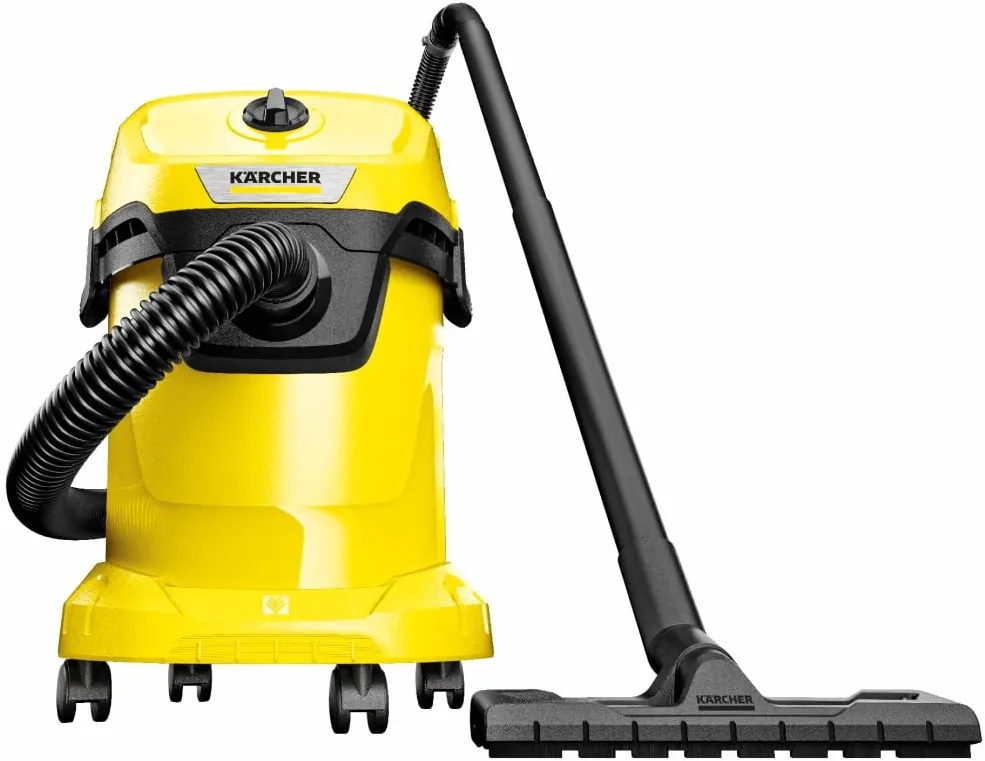
1000 W, a 17 L tank, a cartridge filter for water and dust, a blower and a compact 4.5 kg format: the essentials for home, workshop and car.
- 1000 W
- 17 L
- Blower
The example of the Kärcher WD 3 V-17/4/20
The WD 3 V-17/4/20 illustrates how to read the figures:
- 1000 W power input: moderate consumption, compatible with any household socket;
- 230 W suction power: the figure to remember to compare it with other models in the range;
- 230 mbar: a good vacuum for water and heavy debris;
- 45 l/s: a decent airflow for sawdust, leaves and light debris.
In practice, Auto Zeitung rated the suction power of the WD 3 S V-17/4/20 version as high, close to the best appliances in its comparison, and named it the best value. Its limitation lies in the lack of power control, not a lack of power. Our specifications page details each value.
Power and hose diameter
The motor’s power is of no use if the air does not flow freely to it. The hose plays a discreet but real role here. A wider hose offers less resistance to the air: airflow stays high and coarse debris passes without blocking. A narrower hose concentrates suction on a small cross-section, useful for corners, but it blocks more easily with shavings or leaves.
Length counts too. Every metre of hose adds pressure losses, that is, a small drop in vacuum and airflow at the end. This is why a hose extension improves comfort, by leaving the appliance far from the work area, but slightly reduces suction. With the WD 3 V’s 2 m, 35 mm hose, the compromise favours handling and the passage of everyday debris.
Finally, the nozzles change the power you feel. The crevice nozzle reduces the inlet cross-section: the air speeds up, which helps loosen dust from grooves. The floor nozzle spreads suction over a wide width: it covers a surface quickly but sucks less hard at any one point. Removing the nozzle and vacuuming with the tube alone gives the best airflow for coarse debris.
Power, noise and consumption
A more powerful motor often makes more noise, but the relationship is not automatic: the fan design, the insulation of the head and the air outlet count just as much. Kärcher quotes 74 dB(A) for the WD 3 V-17/4/20, a usual level for a consumer wet and dry vacuum, higher than a recent household vacuum.
As for consumption, a 1000 W appliance running for an hour uses about 1 kWh. For household use of a few hours a month, consumption remains modest. It matters more for daily professional use. Power input also helps you choose an extension lead: a 1000 W appliance plugs into a household extension lead of standard cross-section without difficulty, as long as it is fully unwound to avoid overheating.
Power control, missing on the WD 3 V, would reduce noise and consumption on small tasks. In practice, a short task at full power also takes less time: the overall balance remains reasonable.
Five myths about power
- “More watts, better suction.” False: power input measures consumption. Compare suction power, vacuum and airflow.
- “A vacuum that loses power is worn out.” Most often, the filter is clogged, the bag is full or the hose is blocked. A clean is enough.
- “Two brands’ kPa figures compare directly.” Measurement methods differ. Independent tests remain more reliable.
- “You need maximum power for water.” Water is picked up very well with a mid-range appliance. Keeping the nozzle flat and emptying the tank in time matter more.
- “Power depends only on the motor.” The filter, the bag, the hose, the seals and the nozzle weigh as much on real suction.
Testing the suction at home
Without a laboratory, a few simple checks tell you whether your vacuum is working at its best. Hold the end of the hose, without a nozzle, against the palm of your hand: you should feel firm suction straight away. Then do the same at the tank opening, hose removed: if suction is strong there but weak at the end of the hose, the hose or a tube is blocked. Lastly, listen to the motor: a sharper, higher-pitched sound with weak suction usually means a full tank or a clogged filter. These checks take less than a minute and avoid blaming the motor for what is often a simple maintenance issue.
Choosing on power: the short version
If you only remember one thing, remember this: compare suction power, vacuum and airflow within a brand, then check independent tests, and give as much weight to the filter as to the motor. A wet and dry vacuum around 1000 W with about 200 mbar and 40 l/s covers household needs; beyond that, it is filter cleaning and a tool socket that make the difference, not a few more watts.
Frequently asked questions
Does a 1400 W vacuum suck better than a 1000 W one?
Not necessarily. Watts measure consumption. Compare suction power, vacuum and airflow.
How do you convert kPa to mbar?
Multiply by 10: 23 kPa is 230 mbar.
Why is my vacuum losing power?
A clogged filter, a full bag, a blocked hose or an air leak, in the vast majority of cases.
Is power control useful?
For light fabrics and to reduce noise. It does not improve maximum suction.
Are manufacturers’ figures reliable?
They are measured using each brand’s methods and are maximum values. They compare well within a range. Independent tests are a useful complement.
Cleaning without limits.
1000 W · 17 L tank · 2 m hose · 4 m cable · blower · cartridge filter. Prices change often on Amazon: check the price, the seller and the exact version (WD 3 V, WD 3 S, WD 3 P) before you order.
Check the price on AmazonAffiliate link · new tab