Calculator: which wet and dry vacuum for your jobs?
Enter your main use, the volume of water to pick up, whether there is fine dust, whether you need a tool socket and the distance to your socket: the calculator tells you whether the WD 3 V suits you and how to set it up.
Calculator: which wet and dry vacuum for your jobs?
Answer a few questions: we tell you whether the Kärcher WD 3 V-17/4/20 suits you, how to set it up (with or without a filter bag) and how many times to empty it for a given volume of water.
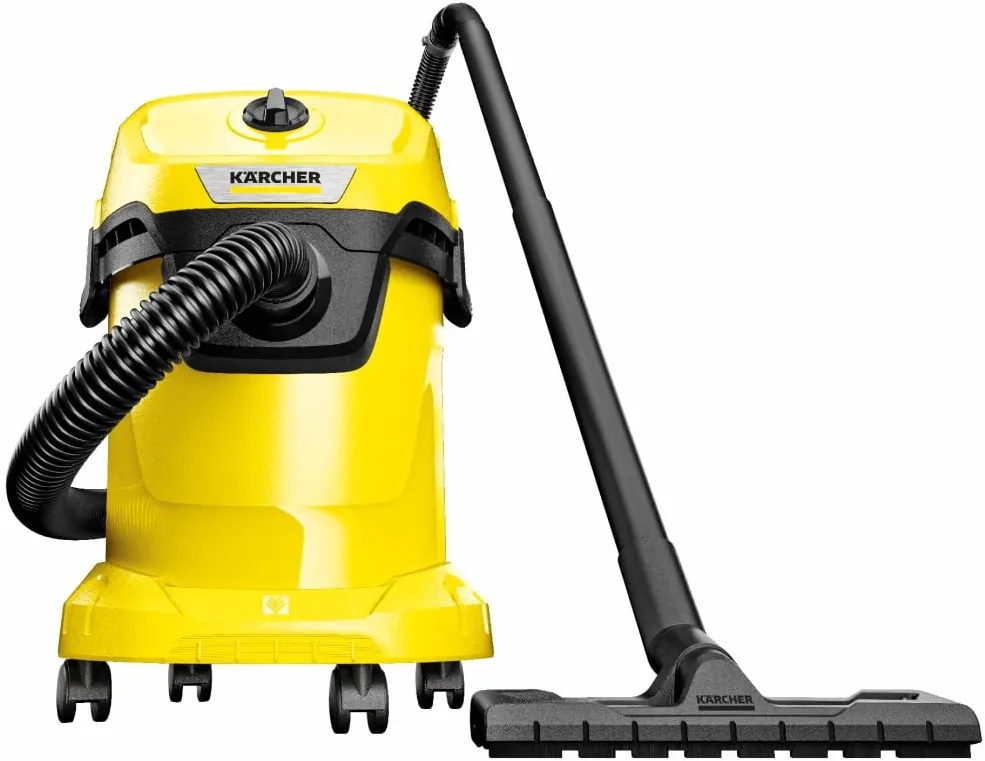
1000 W, a 17 L tank, a cartridge filter for water and dust, a blower and a compact 4.5 kg format: the essentials for home, workshop and car.
- 1000 W
- 17 L
- Blower
How the calculator chooses the appliance
The rules are simple and public. They reflect Kärcher’s instructions and the limitations described in our guides, with no opaque algorithm.
| Your situation | Advice |
|---|---|
| No fine dust, no tool to connect | The WD 3 V-17/4/20 is a good fit, cartridge filter alone |
| Fine dust (plaster, sanding, cement) | The WD 3 V fits, with a filter bag |
| Power tool to connect | A model with a tool socket, such as the WD 3 P |
| Fine dust on a renovation job | A model with filter cleaning |
The logic rests on two documented facts. Kärcher states that a filter bag is necessary for fine dust on its WD 3 to WD 6 models. And without filter cleaning, a filter loads up quickly during a long sanding job: you then have to open the tank to clean it, which becomes tiresome day after day.
How the number of emptyings is estimated
The calculator divides the volume of water entered by the tank capacity, 17 litres, and rounds up to the next whole number. For 40 litres, it therefore shows 3 emptyings.
This is a minimum. The float closes off suction before the water reaches the filter, so the usable volume is a little below the nominal volume. In a flood, also count the water you cannot see: what has soaked under a cabinet or into a rug. Our guide vacuuming water gives pointers for estimating a volume.
| Situation | Indicative volume | Minimum emptyings |
|---|---|---|
| Puddle under a sink | 2 to 5 L | 1 |
| Washing machine leak | 10 to 30 L | 1 to 2 |
| Burst 100 L hot water cylinder | Up to 100 L | Up to 6 |
| Children’s paddling pool | 100 to 300 L | 6 to 18 |
These volumes are editorial orders of magnitude, not measurements. Beyond a hundred litres or so, a submersible pump becomes more practical than a vacuum.
How the reach is calculated
The WD 3 V-17/4/20 has a 4 m cable, a 2 m hose and two 0.5 m tubes according to Kärcher. The calculator uses a reach of about 7 m around the socket, since you rarely use the full length in a straight line. If the distance entered exceeds 7 m, it recommends an extension: an electrical one, suitable for outdoor use if needed, or a hose extension, with Kärcher’s 3.5 m extension.
The data used
| Data | Value | Source |
|---|---|---|
| Tank capacity | 17 L | Kärcher France |
| Cable | 4 m | Kärcher France |
| Hose | 2 m | Kärcher France |
| Tubes | 2 × 0.5 m | Kärcher France |
| Bag for fine dust | Necessary on WD 3 to WD 6 | Kärcher FAQ |
| Liquids | Without a bag | Kärcher FAQ |
| Tool socket | WD 3 P version | Kärcher France |
| Filter cleaning | WD 5 and WD 6 | Kärcher France |
The calculator’s limitations
- It does not take hazardous dust (asbestos, lead) into account, which calls for certified professional vacuums and specific procedures.
- It does not deal with ash, which Kärcher advises against vacuuming with its wet and dry vacuums.
- The water volumes and the reach are estimates: only your real situation counts.
- It recommends a set-up; it does not replace the appliance’s manual.
To go further, our guide how to choose a wet and dry vacuum goes through all the criteria.