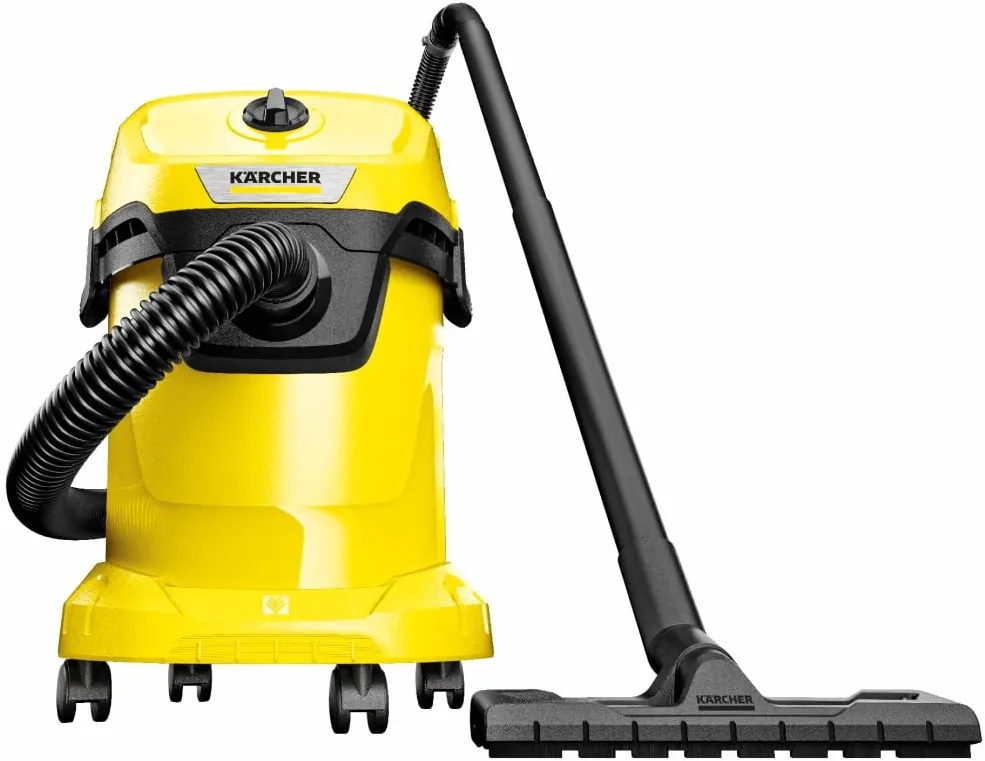
Kärcher WD 3 V-17/4/20: the specifications explained
Every feature of the WD 3 V-17/4/20, its source and what it changes in practice. No invented figures: when a value is not published, we say so.
Contents
The full table
| Feature | Value | Source |
|---|---|---|
| Power input | 1000 W | Kärcher France |
| Suction power | 230 W | Kärcher France |
| Vacuum | 230 mbar maximum | Kärcher France |
| Airflow | 45 l/s maximum | Kärcher France |
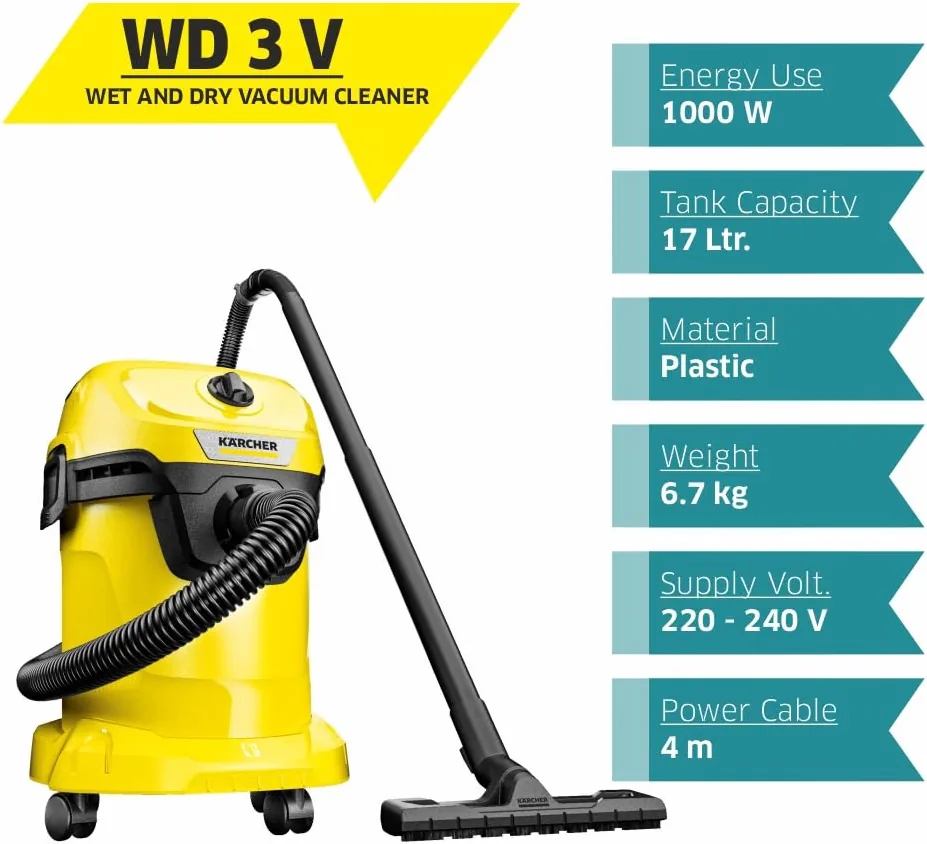
| Tank capacity | 17 L | Kärcher France |
| Tank material | Plastic (polypropylene) | Kärcher France, Amazon |
| Cable length | 4 m | Kärcher France |
| Hose | 2 m, Ø 35 mm, removable curved handle | Kärcher France |
| Tubes | 2 × 0.5 m | Kärcher France |
| Filter | One-piece cartridge | Kärcher France |
| Filter bag | 1 fleece bag supplied | Kärcher France |
| Sound level | 74 dB(A) | Kärcher France |
| Voltage | 220 to 240 V | Kärcher France |
| Weight without accessories | 4.5 kg | Kärcher France |
| Packed weight | 6.6 kg (6.7 kg on the range data sheet) | Kärcher France, data sheet 1.628-101.0 |
| Dimensions (L × W × H) | 349 × 328 × 492 mm | Kärcher France |
| Blower | Yes | Kärcher France |
| Tool socket | No (WD 3 P version) | Kärcher France |
| Filter cleaning | No | Kärcher France |
| Power control | No | Auto Zeitung |
| Guarantee | 2 years | Retailer listings |
Power: 1000 W, 230 mbar, 45 l/s
Four figures describe the WD 3 V’s power, and each one measures something different.
- 1000 W power input: this is the motor’s electricity consumption. It helps you size the socket and the extension lead, not judge suction.
- 230 W suction power: the power actually transferred to the air. This is the most telling figure for comparing two appliances from the same brand.
- 230 mbar vacuum: the maximum suction force, with the opening almost closed. It matters for heavy debris and water.
- 45 l/s airflow: the volume of air moved, with the opening wide. It matters for leaves, sawdust and light debris.
In practice, vacuum and airflow combine: an appliance that sucks hard but moves little air lifts gravel well and leaves poorly, and vice versa. Our article power: watts, millibars and airflow explains this relationship in detail.
The power cannot be adjusted on this model. Auto Zeitung notes this as its only significant criticism, while rating the suction as high.
17-litre tank
The 17 L tank is made of plastic, described as polypropylene on the Amazon listing. It sits on four swivel castors and is protected by a bumper.
The usable volume for water is slightly below the nominal 17 L: the float closes off suction before the water reaches the filter. With fine dust and a bag, the usable volume depends on the bag’s capacity. For dry debris, the tank can be filled almost completely.
A plastic tank is light and does not rust. It scratches and marks more quickly than a stainless steel tank, which makes no difference to suction.
Filtration
The WD 3 V uses a one-piece cartridge filter, which lets you vacuum wet and dry dirt without changing the filter. Kärcher also supplies one fleece filter bag, to be used for fine dust and removed for liquids.
Kärcher does not publish a filtration class (such as M or H) for this household model: it is not certified for hazardous dust. The filter is cleaned under running water, without rubbing or brushing, and must dry completely before being used on dust again.
Hose, tubes and cable
The hose is 2 m long with a 35 mm diameter and a removable curved handle: you can fit the nozzles directly onto the hose, without the tubes, for the car or corners. The two 0.5 m tubes slot onto the handle so you can work standing up.
The 4 m cable, together with the hose and tubes, gives a reach of about 7 m around the socket. A 3.5 m hose extension is available as an accessory.
Accessories included
- 2 m suction hose with removable handle;
- two 0.5 m suction tubes;
- a clip-on wet and dry floor nozzle;
- a crevice nozzle;
- a cartridge filter;
- a fleece filter bag.
This list matches the Kärcher France product page and the Amazon listing, which mentions a “fleece filter bag”.
Convenience features
| Feature | What it is for |
|---|---|
| Blower function | Blowing leaves, dust and shavings |
| Hose storage on the head | Storing without tangles |
| Cable hook | Winding the cable |
| Accessory storage | Keeping tubes and nozzles on the appliance |
| Storage surface | Putting down screws and small parts |
| Folding handle | Carrying and storing |
| Parking position | Resting the tube during a break |
| Bumper | Protecting the tank and furniture |
| 4 swivel castors, no brakes | Moving the appliance |
| Pull & Push lock | Opening and closing the tank in one movement |
| On/off switch | Simple start |
Weight, dimensions and noise
Kärcher quotes 4.5 kg without accessories and 349 × 328 × 492 mm. The packed weight is 6.6 kg according to Kärcher France, and 6.7 kg on the range’s technical data sheet. The difference comes from the packaging and the accessories. The stated sound level is 74 dB(A).
What it does not have
- No tool socket: it is found on the WD 3 P, with automatic start.
- No filter cleaning: it is found on the WD 5 and WD 6.
- No power control.
- No certified filter for hazardous dust.
- No brakes on the castors.
Consumable references
According to the technical data sheet for the WD 3 range (reference 1.628-101.0), compatible accessories include:
| Accessory | Kärcher reference |
|---|---|
| Cartridge filter | 2.863-303.0 |
| Filter bags | 2.863-314.0 |
| Interior cleaning kit | 2.863-304.0 |
| 3.5 m hose extension | 2.863-305.0 |
| Extra-long crevice nozzle | 2.863-306.0 |
| Tube extension | 2.863-308.0 |
| Blower adapter kit | 2.863-373.0 |
| Car kit | 2.863-316.0 |
| Home kit | 2.863-356.0 |
| Brush kit | 2.863-221.0 |
| 1 m tool kit | 2.863-112.0 |
| Drilling dust collector | 2.863-234.0 |
Check compatibility on the product page before buying an accessory.
The WD 3 V against the rest of the range
| Model | Filter | What it adds |
|---|---|---|
| WD 2 | Foam, bag mandatory for dust | The simplest |
| WD 3 V | Cartridge | Wet and dry without a change, blower |
| WD 3 S | Cartridge | Stainless steel tank |
| WD 3 P | Cartridge | Tool socket with automatic start |
| WD 5 and WD 6 | Flat filter | Filter cleaning, bigger tank |
How to read a wet and dry vacuum spec sheet
The WD 3 V’s spec sheet is a good example for reading any other. A few reflexes help you avoid being misled:
- Separate consumption and suction: power input in watts is not suction power. Look for the “suction power”, “vacuum” and “airflow” lines.
- Check the units: 230 mbar equals 23 kPa; 45 l/s equals 162 m³/h. Convert before comparing.
- Distinguish weight without accessories from packed weight: the gap can exceed 2 kg.
- Look for what is missing: tool socket, filter cleaning, power control, filtration class. An absent line usually means an absent feature.
- Count the consumables supplied: one bag is not the same as a pack of five.
These checks take two minutes and spare you most surprises on delivery.
Our sources
- Kärcher France product page for the WD 3 V-17/4/20 and Kärcher’s FAQ on wet and dry vacuums.
- Technical data sheet for the WD 3 range, reference 1.628-101.0.
- Amazon listing for the Kärcher WD 3 V-17/4/20.
- Auto Zeitung, comparison of wet and dry vacuums, May 2025, WD 3 S V-17/4/20 version.
- Listings from major retailers for the guarantee.
Cleaning without limits.
1000 W · 17 L tank · 2 m hose · 4 m cable · blower · cartridge filter. Prices change often on Amazon: check the price, the seller and the exact version (WD 3 V, WD 3 S, WD 3 P) before you order.
Check the price on AmazonAffiliate link · new tab